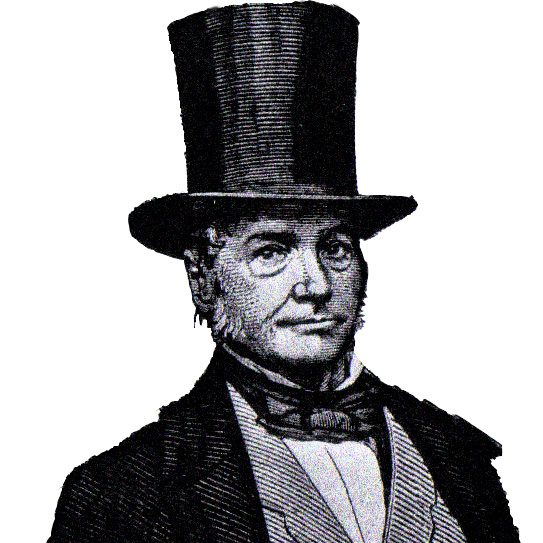

The more I consider my eventful life, the more I am satisfied that there are coincidences that cannot be explained on the common calculations of Chance, because, though I have attributed many of my lucky hits to her, whom I call my patroness, yet I am quite sure her ladyship, though by no means a Lady Bountiful1, is very much a Lady Grateful, who insists on something being done by her favourites to deserve her attention—perhaps a little flattery, though I am not much in that way. About 1840, a very young boy, in Bo’ness, was sent by his masters,—shipowners, I think, there,—with £200 to place in the bank to their credit. As he went along, he was met by a man, holding a good character, and following the profession of a schoolmaster. Seized, it must have been, by the very demon of ambition, or perhaps sick of unbreeching and birching,—which seemed to do no good in the world, as the people were all as bad notwithstanding as he felt himself to be in his heart, in spite of all the birching he himself had got,—he fell upon the boy, who, he had suspected, was the bearer of money, and by sheer force took the whole sum from him. How, in so small a place, and at noon-day, he could have escaped, is a mystery I never heard cleared up, but true it is he did escape from the town, notwithstanding of the hullaballoo that got up in the neighbourhood. If he had taken to any of the country-leading roads, especially that to Edinburgh, he would have been seized; and I have always held the probability to be, that he sought refuge in some of the low, disreputable houses, where the inmates have a strong sympathy for custodiers of cash, so long as it lasts, thereafter kicking them out; and “ serve ’em well.”
We got, of course, information; but, after some weeks, I concluded that the man had either never come to Edinburgh, or had quickly left it. His crime was there, however, where it made a considerable noise from its peculiarity; for though dominies2 have often vices, it is seldom they betake themselves to the highway. When I know a man is not under the changeful wing of an alibi, he must be got of course—that’s certain. That’s a rule with me; but never having considered myself omniscient, the moment I am satisfied a man is not on my beat I
can be easy. But then my beat was certainly a pretty wide one, and the difficulty was to find out one negative among so many positives as some two hundred thousand; and somehow I am a hard hoper, so that my conclusion was rather a forced matter in this case.
About a week or ten days after the affair, I was one night taking a turn along Bristo Street, a little in the knight-errant way, looking out for some pretty Lady Virtue, in defence of whom, under the brutalities of her ungallant sons, I might break, not a spear, but a head. On the pavement there stood two young girls, speaking, with their bonnets nid-nodding against each other, and looking with eyes so scandalously full of scandal of some very captivating kind, that I was induced to stop.
“ What now, my lasses ? ”
“ Fine night.”
“ Where do you belong to, now ? Edinburgh lasses —eh?”
“ No, Bo’ness,” said one of them. “ Bo’ness ! Oh, you must have heard of the schoolmaster who robbed the boy ? ”
“ Ay, and just speakin’ o’ him,” said the second.
“ Do you know him ? ” asked I, just with the proper carelessness.
“ Brawly; he has whipt me before now, and I wadna care though he was hanged in his ain lang tawse, for his cruelty to me mony a day.”
“ Well, perhaps I may help you to repay him,” said I; “ one good turn deserves another.” Thereupon one, shooting out her face so as to be very near my ear, said, “ Whisht! ”
“ Why ? there’s no one near.”
“ Nae saying; he’s in that public-house there,” pointing with her finger.
“ Stop there till I come,” said I, and instantly walked in.
I got into a room where there was a man, threw my eye over him, and there to be sure was Mr ________. I took no time to scan; you only raise suspicion. A glance gave me the “ nose somewhat turned up the “ demure face,” as if so tired of whipping urchins; “ gray eye,” far ben, so indicative of foxiness; “ big upper lip,” of sensuality; “ no whiskers,” where whiskers should have been ; and, beyond all, the look of great reverence, as if he had been bred to psalm-singing.
“ Fairish night,” said I. ‘ “ Middling,” was the gruff reply of my schoolmaster.
“ Bring me a bottle of ginger beer,” I cried, suddenly,
to the man of the house. If any one will guess why I called for a drink I despised on a coldish night, when perhaps I needed something to warm me under the freezing look of his reverence, I’ll give him my baton. Just guess now, and fail. It was not, I assure you upon my honour, that I might treat the girl whom he had whipped. Be so good as keep that in mind, because you might call me a fool for proposing a puzzle which was no puzzle.
My beer came in, and, going to the door, I brought in the whipped Jenny. “ Take a little beer, lass,” said I, cheerfully. But she couldn’t, for her eyes were fixed on the dominie,—in the recollection” probably of the tawse,— and her whole body shook
“No fear,” said I; “no tawse here, lass.”
But still she stared and he stared, and they would have kept staring until all the froth on the beer had passed into thin air, if I had not put an end to it. “You know the manl” said I to the girl.
“ Ay—that’s him,” replied she, still staring at him, as if the old charm of the tawse tingled somewhere about her body. “ Who ? ” rejoined I
“ Mr _______ , the schoolmaster o’ Bo’ness.” “ Well, give me your name and address,” said I, getting out my pencil, and proceeding to make the important entry in that terrible red-book of mine. “ Now, my bonny lass,” continued I, “ your name is given up to the dominie, who’ll decry you; but never mind. You may go now, but ‘still remember me.’ ”
And she went, still all of a tremble, and forgetting her beer entirely. “ Well, I have the pleasure of having before me Mr ________, late schoolmaster at Bo’ness ? ”
“ It’s false, sir.”
“ At any rate a supposition’s no dime, and just let us suppose it.”
“ I’m not to suppose any such thing.”
“ Don’t want you—it isn’t necessary. It is only necessary that I should, and, what is more, I do. And I also suppose you have something in your pocket which would be very interesting to me.” “ I am a respectable man ”
“ I’m not disputing it.” “ And I see no authority you have to inquire what I carry with me.” “ Well, you may put me down as impertinent. I am sorry for it, but I am often obliged to be uncivil—cant really help it. Turn out.”
“ ’Twill do you no good,” said he, sulkily, and fumbling in his breeches-pocket.
“There’s all the money I have,”—putting some silver upon the table,—“if you’re a robber, take it.”
“I don’t happen to belong to that fraternity, I am a robber-catcher.”
I had got the whip-hand of the reverend dominie. He shook violently, and knit his brows to make amends.
“ You are pale, my good sir,” said I, “ and my beer’s done, but I see you have got some in your coat-pocket,” —pointing to the top of a bottle sticking out, and which I had seen when I called for my own, through sympathy or fun; for we sometimes, when prosperous in our calling,
get merry at the expense of vice. And why not ? Are we not men ? Have we not eyes, noses, hearts to feel, and lungs to laugh, and all the rest ?
“What mean you? ” he said, looking at me as if those far-ben eyes had come an inch out of their dark holes. “Just to give you a drop of your favourite beverage,’’ said I, pulling out a bottle from his right pocket. “ Ah! and here is one for me as well,” taking another from the left; “and here’s a third for Madam Justice,” taking the remaining one from his breast-pocket.
“ I get beer at this house,” said he, “ and bring back the bottles to get more.”
Here I was certainly a little taken aback. The explanation was really plausible, and I thought for a moment my drollery had been folly—that however brisk the beer I had called for, my joke had been stale.
“And now you see,” said he, profiting by my disadvantage, “ what you have made of your impudence.” But then, I think I have said that Vice is liable to infirmities. When she gets merry she gambols, like the moth, and rushes into the candle; or crows like the cock, who, getting on the heap-top, and then into the claws of the eagle, would never, but for the cocky-leerie-la of his jubilation, have been seen by his big friend. Yes, my reverence here committed a mistake;—probably though he had not, I would have been up with him. And then, with all the coolness in the world, he actually took up one of the bottles, and was putting it into his pocket. “What! didn’t you say you had brought these empty bottles?—for that they are empty,” I continued, as I lifted one, “ there can be no doubt; and why put them back into your pocket again to trouble you by taking them out a second time? ”
“ That’s my business,” said he. “ And this is mine,” said I, taking up a poker in one hand and a bottle in the other, and knocking the head and upper part clean off, when there appeared a nicely rolled up bundle of notes, about £50. The sound of the broken bottle brought in the landlord.
“ Just in time,” said I, taking the man by the coat, and drawing him forward. “ You see this ?—it may be necessary you testify to it. This bottle, which I have taken from this gentleman, is
more wonderful than that one I have read of in ‘ The Devil on Two Sticks3,’ for it contains this bundle of notes. Let us try our luck again,” I continued, as I broke the second, and then the third, each revealing a similar bundle of notes, amounting in all to upwards of £150. “ Do you put pound-notes in your ginger-beer bottles when you cork them up for sale? ” The man laughed, even in the midst of his bewilderment. . “ The deevil o’ the like o’ this ever I saw ! ” he said; “ what is the meaning of it ? Ah, I see, you ’re
a conjuror.”
“Just so.” “ I wish you would conjure some of my bottles that
way. Faith, an’ I’d soon be a rich man.” “ I only do it to my friends,” I replied, as I took a
look of Master Reverence; “ but no more of this joking; you have seen what you have seen, and can speak to my conjuring when you are called upon by an officer from the Sheriff.” The man began to see a little better. “ I understand,” said he. “Well, you may go.” “And now, sir,” addressing my prisoner, “you will please go with me to the Police-office; I will take care of
your bottles.”
“What to do there?” he said, scarcely now able to speak with fear. “ To answer to the charge of robbing the boy in Borrowstounness, a week ago.”
I now began to gather up my broken bottles; and as I proceeded, I heard him sighing and breathing laboriously; words came too, as if he had forgotten I was there. The spirit was working within; the conscience up in war, tearing him; he threw himself back on the chair, with his legs out, and as he hauled these shuffling along the floor, he still muttered—I could scarcely make it out, yet I was satisfied of these strange words, which I have never forgotten, and never will forget— “ Good God ! this very girl I punished severely without a fault, because I had a grudge against her father !”
So, so, I thought; and what hand led me here so that I should come upon this girl, and what power stopped me, what power opened my mouth? Silence! I am only a humble instrument for discovering the secret ways of man’s wickedness. Yes, I have often been impressed with this feeling when people thought I was merely pleased with my own poor efforts. Maybe they did not know me, for these thoughts are not just suited for the Police-office; and then, I have been obliged to stand the look of great judges, who, while they complimented me, no doubt looked upon me as a poor machine, only moved by strings pulled by a love of being thought clever, while they, who act upon my detections, are so wise and so honourable. But every man to his trade—shoemaker, poet, judge, and last—excuse me—the ferreter out of evil.
It is easy to “ charge ” on such labours as mine,—easy to pronounce the word guilty, as proved by them,—easy to hang, as a consequence of them; and yet no man has less reason to complain than I myself. “ I love a penitent,” said I, as I turned round to the miserable man. He did not relish the compliment; such people never do.
“ Mind your own business; you have been insolent in your wit.”
Ah, there’s no pleasing them: if you are harsh, they say you are riding over them; if mild, you are gloating over your superiority; if humorous, you are cruel and ironical.
“ Suppose then,” said I, “ I command you as a suspected ”
“Just suspected.” “As a suspected robber of a poor helpless boy, not much beyond your birch ”
“Peace, man; your words enter my soul.”
“ Who might have been suspected of having appropriated that money, and been ruined for ever, to ”
“ Peace, peace!” “Walk up to justice;—will that please you ’
“True, true !” he ejaculated; “what will please him who has displeased God, and therefore himself? Were you to speak as an angel, I would call you devil; and devil you are!”
“ Well, you -will admit that the boy’s masters, when they get the contents of the bottles, will not have so bad an opinion of me; you know there’s a reward.” “But none to me,” he sobbed, as his head fell on his breast; “ my reward will not be here.”
“Not sure but it may begin here, and in a way which may lead you to rejoice that it does not end here. A little sharpness quickens a man’s conscience, and when that begins to cry out, you know there’s a voice that answers.”
“ Well, you are not so bad a fellow after all,” he said; and, rising, “ now I will go with you quietly, for I think God’s mind is in me, and perhaps He may lead me through tribulation to exultation.” “But what put the bottles in your head?” said I, changing the subject, for really I felt curious, though I have seen all manner of hiding places, even the tender arm-pits of women,—yes, their mouths speaking sweet, endearing words,—but a ginger-beer bottle was new to me.
“Because,” replied he, “after my first run I got thirsty, and having, in a public house, got a drink of ginger beer, and as the empty bottle stood before me, I thought it would be a good means of hiding. No doubt the devil put this in my head, because he knew there was a man in Edinburgh who understood the devil’s ways, and would find me out. But what,” he asked, after a pause, “made you call for ginger beer when you entered? The words went to my very heart.”
“ Because,” said I, “ the devil induced you to allow a neck to stick out. I suspected in an instant that the money was there.” “ Strange, indeed! ”
“ And I was so amused with myself, that I called for a bottle, just as a playful way—for I do my business with good humour—of intimating to you that I knew your trick.” We had talked more than I am in the habit of doing generally. I took him, with the broken bottles and notes, up to the office. “ There,” said I, to the Captain, “ is the Bo’ness gentleman, and there is the money—all but fifty pounds— and there are the bottles where the money was secreted.” These were enigmas; but when the Captain understood them, he did not know what to say, between a desire to laugh and some restraint he could not comprehend.’ “Ah!” said he, at last, “M‘Levy, we should have a pulpit here, where people might be taught by us, as preachers, that God has many ways of finding out the wicked.” The prisoner was sent on to Linlithgow, along with the notes and broken bottles, and afterwards sentenced to fourteen years. The Judge complimented me handsomely; not so the offerers of the reward, for they never gave me a penny. The £25 went to the girls. I did not begrudge the gift; and yet, somehow, though not fond of money, more than is necessary for my humble wants, I think I should have got a five-pound note to wet my throat with ginger beer when following up the devil.
- Lady Bountiful
This is a well-known literary and cultural figure, originating from George Farquhar’s play The Beaux’ Stratagem (1707).
Meaning: A wealthy, charitable woman who helps the poor but often with a patronizing or self-important attitude.
In McLevy’s story: The reference could be ironic or critical, suggesting someone who enjoys the appearance of generosity more than truly understanding or aiding those in need. It may also indicate a stereotype of wealthy women meddling in affairs with good intentions but little real impact. ↩︎ - dominies – schoolmasters ↩︎
- The Devil upon Two Sticks – A novel published in 1707 by the French writer Alain-René Lesage. It is set in Madrid, and tells the story of the demon king Asmodeus, Don Cleophas Leandro Perez Zambullo and his beloved, Donna Thomasa. In the novel, Asmodeus is imprisoned in a bottle. ↩︎
 James McLevy