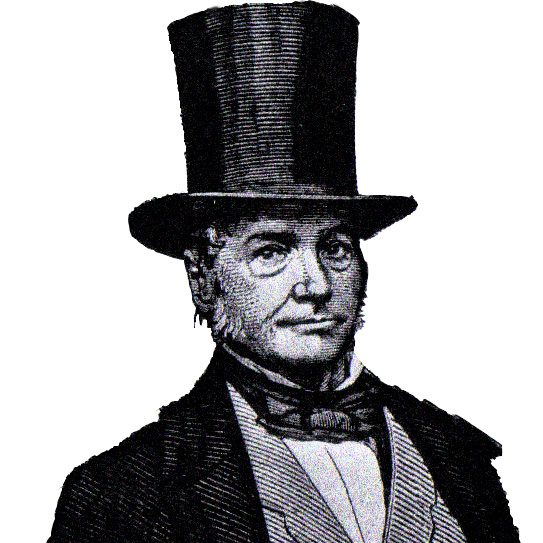
In the year 1836, which was in Mr Stewart’s time, information came to the office from the quiet town of Peebles,—so quiet, that Lord Cockburn says, in some of his books, “ if you want to make a public proclamation anywhere so as not to be heard, go to Peebles, and it is buried forever,”—that the house of a gentleman there had been robbed on a Wednesday night, and a number of articles, among which were a new greatcoat and a pair of Wellington boots, had been carried off. However deaf Peebles may be to a proclamation, it certainly—at least among the high authorities there—cannot be charged with insensibility to the breach of the laws, for a capital account it was which we got, embracing all the particulars, the articles carried off, and the description of a person, once a servant in the family, who was suspected of the breaking-in and the abstraction. There was only one want—not a hint of the direction the burglar had taken—whether east, west, north, or south; only that he was off somewhere. The affair was entrusted to me, but I wanted that indispensable condition of hope—the certainty, or at least probable suspicion, of his being in Edinburgh. However, I transferred the image of the fellow to my mind’s eye by that inside photography I have a knack in. I never knew where the light comes from, but the image, if once there, does not need any “ gall ” of anger to fix it, rather only the honey of love. I had him set up in that inside-plate accordingly, as large and living
as life:—six feet two—dark complexion—leg-of-mutton whiskers—drooping nose, as if too heavy for the forehead to sustain—small mouth under the same, sadly oppressed by the said nose, and as if afraid to open under so formidable an incumbrance—something of a squint, under a bush of eyebrow. As for clothes, uncertain, unless he exchanged in the morning, and put on the new greatcoat and boots, which, for the sake of completing the picture, I supposed he had done; and so I had my man’s image safe in my mind’s keeping. But where was the original? I have always had a yearning for those comparisons, however odious, between the mind-sun- picture and the real walking, breathing piece of humanity itself, however low and degraded; but the desire is fruitless without the one of the two sides of the comparison.
Two days passed without issue, and it was now Saturday night. I had had the image all right for twice twenty-four hours, but where was the lantern?
Even that would shew me the honest man in the dark,— more difficult then to be seen, though present, than at noonday, as in the old case; nor have we more of that class now than then, I suspect. I wanted my “ idea,” and it was not a case exactly of time; another day might as well pass without diminishing my chance of success. I would wait for my “ idea,” just as the poets do, I’m told — not considering themselves bound to work unless they’re sure they have it, though some tell me that many try without it. Better they than I, for I never did any good without mine. It might come by chance. True, what have I not done, in my small way, by chance ? Ay, but Chance never smiled on me unless I poked her (is she female?) some way; so that my “notion,” after all, has been, in the getting of it, my own work, only perfected by a higher hand.
In this dubious, stupid kind of state I left the office, intending to go home; nor, before I came to Toddrick’s Wynd, had I any intention to poke up my favourite goddess; but, just as I was passing by the entry, my right leg I found inclined to the south, and the one leg carried the other, and both my head, which, so drowsy was I, seemed to be quite guiltless of the change from my right line home to bed down that same close. Habit, I fear, had some part in this wilfulness of my lower members. A Mrs Taylor lived down the wynd, a famous keeper of a half-respectable kind of lodging- house—a species of pool whence I have drawn many a kipper, as well as full-roed fish, newly run, with no other bait than a sombre “ March-dun1,” or sober “ May-bee ”—and with a lazy floating line, too, without a bit of barling or whipping. Yes, I had been so often there, that I might be said to have formed a habit of going, for that kind of comfort without which I do not think I could live in this world of man-and-woman wickedness. Having opened the good woman’s door,—I call her good, because, if her lodgers were often only half-respectable, she was wholly so, at least in my eyes,—I entered with my usual familiarity, and sat down with her by the fire. I have said I wanted comfort, and so I began my old way of asking for it.
“ Any lodgers just now ?” “Ay, a man frae the country. He came early in the morning, and got his breakfast. He is to sleep a’ night at ony rate.” “ What like is he?” I inquired.
“ A perfect Anak amang the Philistines! Ye’re a guid buirdly man yersel’; but, my faith ! ye ’re naething to him. The man, I fancy, is guid eneugh; but I wadna redd you meddle him—I mean if he were ane ye had ony care for—without at least twa assistants.”
“Can you describe his face?” said I, really in the expectation of getting nothing.
“ Indeed, no,” replied the good woman, “ for it’s lang since I gave up spying into men’s faces, whaur I never, in my best days, saw muckle to look at, but a nose amang a bush o’ hair, and twa een aye glowerin’ at us women-folk; but, besides, my niece Jenny gave him his breakfast, and I’ve scarcely seen him;—but, Guid save us! here he is,” she added, as she heard a heavy foot in the lobby. And so, to be sure, the big lodger entered, very confidently, drew in a chair, and sat down. I threw my eye over him on the instant, not of course very inquiringly,—for, indeed, as I have already said, a glance generally does my purpose,—and there was the nose, so much too heavy-like for the forehead, and the mouth under the incumbrance of the nose, the leg-of-mutton whiskers, and the squint, all so perfect, that my mind-sun-image leapt within me, as if it would be out to its original, there to lose itself in Iflesh and blood. Enough for the justification of my modesty and simplicity, and taking-it-soft method—nay, I’m not sure if the man had observed whether I looked at him at all or not, and, as for the future of our companionship, I did not need. I had something else to do—I had caught my “ idea,” as well as its original; but then the one was a fancy, and the other a “ Tartar.”
The conversation was meanwhile leading to trades and occupations; how it began I cannot tell; but all of a sudden it came into my head to say to my man, “ You ’ll be a hawker, no doubt ? ”
“ Are you a hawker ? ” replied he, rather in a surly tone, as if offended. “ Yes,” said I.
“ I thought as much,” growled he, “ for we think everybody we meet should be like ourselves.”
“And yet we don’t find that always,” I rejoined, softly. “But I could wish every man were as well to do as I am, for I have six men on the road, and a horse seldom off it.”
“ The horse will be for yourself? ” said he.
“ Yes; I could not get on without my Rory; for, you know, I have all those six fellows to look after.” “Why, don’t they return at the end of their rounds ? ” inquired he, again. “ Yes, if they are able.”
“ And what’s to disable them ? ”
“The fiend drink,” said I, somewhat sorrowfully.
“ They get into wayside publics, and sometimes lie for days—all the while my goods are being stolen.” “And what do you do with them when you find them in this state ? ” said he. “ Turn them off, I fancy, and get more sober men ? ”
“ No : were I to do that, I would be changing every week, and with no chance of getting better ones; for if they don’t drink, they cheat, and a drunken honest pedlar is better than a sober dishonest one.”
“ Why, then, you must just let them sleep off their drink,” said he, “ and trust to a sober run to make up for the drunken one ?”
“ No ; I hasten to the spot, and having caught the fellow as he begins to look clear, I handcuff him, and bring him into town with the pack on his back. There I relieve him, and keep him without wages as a punishment, just as long as I think necessary; and when I think he is determined to do better, I give him his pack again, and begin his pay.”
“And is this strange punishment often necessary?” said he, as his curiosity became excited by my novel method. “Why,” replied I, “no longer ago than Wednesday morning, I was obliged to set off for Peebles, where, one of my chaps was lying drunk—and I think I met you” (a chance thrust) “ coming out of the town with a bundle, and that was just the very reason that made me suppose you were one of our order.” “ Well,” said he, thus taken suddenly, “ I did leave Peebles on Wednesday morning with a bundle, but I am not a hawker.”
“ No offence; it is a good honest calling. Once upon a time a great part of the country trade of Scotland was done by hawking, and a pedlar was often worth thousands.”
“ May be,” said my giant; “ but if I were one of your men I would be very drunk indeed if you could hand-cuff me,” “ Perhaps I wouldn’t try one of your size and mettle,” said I, “ unless you were very drunk.” “ And then what the use ? ” rejoined he. “ Drunkenness is a very good handcuffing itself, though I never saw the instrument I have heard so much of, nor would
I like to deserve it. But, man,” he continued, after a pause, during which he perhaps thought he did deserve the application of the check, and maybe shook a little at the prospect of feeling it, “ what are handcuffs—what like are they? Could a strong man not snap them, and then snap his fingers at the officer? ”
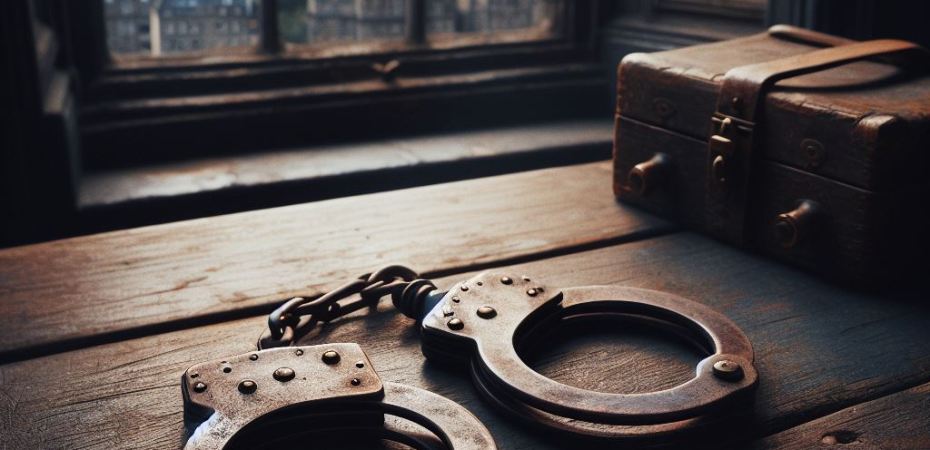
“ A very simple thing,” said I, drawing out a good specimen, which I cherish as my stock-in-trade, maybe with no less affection than Simpson did his bit of hemp, though, in point of respectability, I don’t want the two things to be compared. “ Here is my wrist-curb for my disobedient pedlars.”
I even put the thing into his hands.
“ A very simple affair,” said he, with a sneer; “ but I am d____ d if that would hold me, unless it be applied in some queer way.”
“Well,” said I, “ I never saw one of my men break it or get loose.” “ How do you apply it ? ” said he, looking curiously. “ Why, just this way.” And in, I hope, my usual kindly manner, I put his right hand into the kench.
“ How is that to bind a man ? ” he again sneered.
“ Not finished yet, my dear fellow. I bind the other end to my left hand thus, and there you are.” “ Well, rather kittle, I admit,” said he, looking not quite comfortable-like; “ and I would just as soon be out of it.”
“ But you have not tried it yet,” continued I. “Sometimes a man is unfortunate, and while we are yet innocent and free we might be nothing the worse for preparing for an eventual future, you know. Just suppose that I were not a hawker, but one of those very uncomfortable
men called detective officers, and that I wanted to walk you up to the Cross. Let us see—come along, now; quietly, my good fellow—this way ”—leading him out—-“ so, this way—so,” till I got him to the outer door leading to the close. “ So,—how quiet you are ! You don’t resist. Why don’t you? So”—up the close a bit— “ you said you could snap it, or get loose, and then snap
your fingers, and yet don’t you see ? ”
Even all this time my man thought it play, but whether it was that suspicion seized him, or he merely wanted to try the game, I cannot say, but he began in earnest to struggle; but it would not do. I held him firm by the right arm, and whenever he used the left, I quelled him easily by my right. “ Enough of it,” said he, at last.
“ Not just yet,” said I, with an impassive softness. “ I want to see if I can take you up as far as the Police- office.” “ The Police-office ! ” he roared, with a tremendous growl. “ The Police-office and be d_____ d! Why there ? ”
“ To be searched and examined,” I replied, still keeping my temper, “ and perhaps committed for breaking open your old master’s house at Peebles, on Wednesday night, and stealing, among other things, the greatcoat that’s now on you, and, I believe, also the boots now on
your feet.”
I felt his right arm fall as if palsied. I could see by the lamp at the head of the close that he was as pale as pipeclay. There was not so much pith in this big man as would have sufficed to break a rosin-end of good hemp, nor did he speak a single word. All I heard was his labouring breath, as he heaved his strong ribs, so that he might give room for the play of his heart. I was now safe from an attempt at escape, for we had reached the top of the wynd, where the man in charge of the street immediately came up to my assistance. But somehow I got filled with the demon of pride. I had an ambition to walk him up alone, and though, no doubt, the
appearance of the policeman might have contributed to the continuance of my now easy victory, yet I verily believed he was still incapable—such is often the effect of that striking down of the confidence and courage of a conscious criminal, by a calm announcement, coupled with a mere strap of leather—-of offering any resistance. And thus I took him to the room of the lieutenant, where Captain Stewart happened to be at the time; and here it was he first found voice. “ I am brought here by a hawker. I am not one of his pedlars, and no more drunk than he is himself,” he cried, his mind suggesting some faint hope which, for a moment, blinded him to his fate.
“ Why, M’Levy, you have caught our Peebles friend,” said the captain, laughing, but wondering, too, at my new vocation of pedlar; “ there’s the height, the nose, and all the rest, as large as life. Where, in the name of all that’s wonderful, did you find him ?”
“ Stranger still,” said the lieutenant, “ where’s your assistant? You couldn’t handcuff that giant alone? ”
“ He’s handcuffed, anyhow,” said I; “ call some of the men, for I want to be relieved.”
He was, in a few minutes, safer still—locked up for the night. Don’t, I beg of you, suppose that we are such ill-disposed and gloomy beings, who frequent this outer chamber or entrance to the dempster’s hall, that we never have the luxury of a little quiet mirth. Bless you all, except, of course, those who will not come quietly up to see us, we are quite humane in our way—no hyaena’s laugh or crocodile’s tears amongst our fraternity. We can even enjoy such mishaps as the discomfiture of those who try to put mirth to flight in many a domestic heaven; and can even afford, without detriment to our hearts, to be merry over grief, when it is the grief which follows God’s behest against the disturbers of man’s rest. Then it is only making the balance even, for how glorious do our enemies, whom we yet treat as friends, get in their midnight triumphs of pilfering, robbing, and murdering their fellow-creatures, who not only never injured them, but often served them well, but, alas! not wisely. So I need no apology for that heartily-passed half-hour, during which I explained the capture of my man—one of my six pedlars; but withal, it was nothing but the confidence my superiors had in me that prevented them doubting, not only the means I employed in getting the wrist of this truly big thief into the strap, but my ability to bring so great a giant all so quietly from Toddrick’s Wynd to the Cross of Edinburgh. I was at least comforted, even by Widow Taylor, at whose house I had sought consolation for my two days’ disappointment, and went home to bed without a touch of compunction. Next day, my pedlar, with his pack—collected from several brokers—along with him, was sent to Peebles, where the Sheriff and Jury gave him nine months, to confirm him in a resolution, no doubt formed when he pled guilty, that he would not, even at the bidding of a
hawker, try on a pair of handcuffs again
- March-dun – fly for fishing ↩︎
 James McLevy