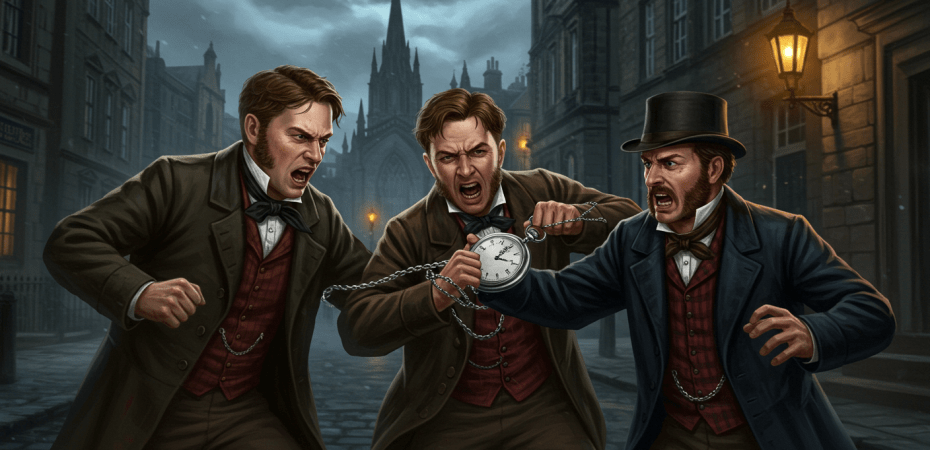
I need hardly say how very much is due to decision in the business of detection. A single minute will often peril the object of your inquiry, and then, it does not often happen—at least I have not found it—that the patience that is required in ferreting is joined to the power of dashing at an emergency. A very singular case, where I had an opportunity of testing myself in this way, comes to my recollection. On the 4th of January 1858, as a man, whose name has by mischance been omitted from my book, was going along the head of the Cowgate, he was instantaneously set upon by three young men, thrown down, and robbed of his watch. A man of the name of M’Ginnes who came up at the moment to lift up the stunned victim, met the robbers as they made off. It was dark, and he had a difficulty in catching marks so as to be able to identify them. All that he could say when he came to the office was only general, so that it would have been impossible to proceed with any certainty on his description. In addition to this disadvantage, it happened that any information that I could get from him was get at the door of the office, where I met him as he hurried in. I was just on the eve of setting out on a hunting expedition, accompanied by my assistant Reilly, with a draper who had got taken from his shop a quantity of goods, and whose case was urgent. However, I got so much from M’Ginnes,—enough to point my mind towards three young men—David Dunnet, Robert Brodie, and Archibald Miller, the last of whom I knew to be a returned convict. Of course, it was impossible that the man could give me any general marks of all the three, nor did he, but it was going far to point out the gang that I got something indicative of one; for when once a gang is formed they fall into a fatal regularity of almost always acting together, so that if you get a clue to one you may consider it a clue to them all. So general have I known this habit among thieves, that I have not found it happen often that while the copartnership lasts they betake themselves to individual adventures. The reason of this is perhaps evident enough. Thieves and robbers have their lines of acting, much like players, and when they determine to go in partnership they agree as to the kind of speculations they will engage in. The particular line of the three I have mentioned was robbery of the person ; and, knowing this, I was the more easily led to the conclusion that they were the parties implicated in this affair. Yet, withal, I must confess that I possessed nothing like a conviction; and, indeed, so much was I taken up with the draper’s business that I sent M’Giimes in into the office to report regularly, when the lieutenant
on duty would, of course, set the proper detective on the scent.
In the circumstances, the affair was soon out of my mind, occupied as I was with the poor draper, who sighed for his goods, and no doubt thought that I was the man to repair his loss. A reputation thus gets a man into toils, but I hope I never regretted this consequence, so long as I could give my poor services to anxious, and often miserable victims. How often have
I walked through Edinburgh in the middle of the night, and far on in the morning,—when all were asleep but those who turn night into day,—accompanied by some silent man or woman, groaning inwardly over a loss sufficient to break their fortunes and affect them for life —threading dark, noisome wynds, entering dens where nothing was heard but cursing, and nothing seen but deeds without shame, endeavouring in the midst of all this sea to find the sighed-for property, or detect the cruel robber. Wearied to the uttermost, I have often despaired, at the very moment when I was to pounce upon what I sought, redeem my spirits, and render happy my fellows.
In the present case I had a task of the same kind. We went through a great part of the Old Town, up-stairs and down-stairs; through long dark lobbies, and into all kinds of habitations, but the draper was not that night, at least, to be made happy. We had entirely failed, and were all knocked up by disappointment and fatigue. If the robbery in the Cowgate had scarcely taken hold of me when we set out, all interest in it had passed away, if not all recollection. Some hope had taken us over to the far end of the Pleasance, and we were returning by that street. It was now between twelve and one,—a dark morning, as it had been a dark night,—every sound hushed, and all thought, it may be said, stilled within us. In short, we were fit only for our beds, to which we were hastening as fast as our weary limbs would carry us. I think we had got as far as the foot of Adam Street, when up came three young fellows so rapidly that they were within a yard of us before they saw us or we them.
“ Seize them,” I cried. And instantly we sprang upon them. I seized Miller and Dunnet each with a hand, while Reilly engaged Brodie. Straightway a fierce struggle ensued, during which I cried, “ Search Brodie.” And no sooner was the cry uttered than Brodie threw something away from him to a considerable distance. The sound of the article charmed the ear of the draper, and instantly running to the spot, he picked up a silver watch—the very watch that had been taken from the man in the Cowgate three hours before. In the meantime the struggle continued, and no man can form an idea of the energy of robbers when caught suddenly after an exploit. Their blood is up before, and the terror of apprehension gives them a power which is just that of self-preservation.
At length, and receiving some aid from our valiant draper, who lost the sense of his loss in a kind of re- ‘ venge against the class from which he had suffered, we succeeded in quelling them, whereto we were probably aided, too, by passengers who stopped to witness the melee. We landed them all safely, and they got their reward. Brodie, who had the watch, was sentenced to seven years’ transportation; Miller, the returned convict, got two years’ imprisonment ; against Dunnet, not proven, for there was no proper identification. I have said that Miller was a returned convict. I am not sure but that the old notion that punishment tends to reformation hangs yet about many minds. For God’s sake, let us get quit of that. I have had through my hands so many convicted persons, that the moment I have known they were loose, I have watched them almost instinctively for a new offence. The simple truth is, that punishment hardens. It is forgotten by the hopeful people that it is clay they have to work upon, not gold, and, therefore, while they are passing the material through the fire, they are making bricks, not golden crowns of righteousness. Enough, too, has been made of the evident enough fact that they must continue their old courses because there is no asylum for them. You may build as many asylums as you please, but the law of these strange nurslings of society’s own maternity
cannot be changed in this way. I say nothing of God’s grace,—that is above my comprehension,—but, except for that, we need entertain no hope of the repentance and amendment of regular thieves and robbers. They have perhaps their use. They can be made examples of to others, but seldom or ever good examples to themselves. That they will always exist is, I fear, fated ; but modern experience tells us that they may be diminished by simply drawing them, when very young, within the circle of civilisation, in place of the old way of keeping them out of it.
 James McLevy