
I need hardly say that the mere value of a stolen article has little to do with the amount of the guilt. The rapacity that strains after a big booty will condescend to a very small one. And, Certainly, in so far as regards the discovery, while a valuable thing creates more interest, and therefore multiplies the means of detection, there may be as much of a curious peculiarity in the trace of the small robbery as in the large one.
In April 1845, we got intelligence that a uniform coat, belonging to a porter in a Life Assurance Company in Edinburgh, had been stolen from the lobby by one of the “ prowlers,” or thieves that go about studying doors and windows, ready to enter on the instant and take advantage of any laxity of care that presents itself. The boldness and sharpness of these worshippers of Chance are extraordinary. I have known instances where members of a family have met them on the inside stairs, and even in rooms, and they have generally an answer that serves them for the moment, till they get off. Then there is the well-known trick, to send the servant in with a message, and when she comes tripping along with the answer she finds the lobby cleaned out. No open door is safe in Edinburgh for a moment; and even intermediate doors that are shut are often opened by the prowler. In the present case, a glass-door formed no impediment. The coat was snatched off the pin, and the red-necked official was deprived of his dress badge. The article with its red neck was what we call ken-speckle, and it was further distinguished by having upon it buttons, cast on purpose, with the name of the Assurance Company upon them; so that it was not one of those things I could look for in a pawn-shop or a broker’s. It would get first into the hands of a tailor, to be shorn of its peculiarities, and transformed into a shape that would enable the thief to get it disposed of; but then no ordinary tailor would have anything to do with it; and, therefore, it appeared to me that it would cast up in the hands of some low snip, who devotes him- self to such transformations. There is a difficulty about all such things, but here it was increased by the exclusion of the ordinary places of deposit. This small affair of the red-necked coat tickled me a little. I took a fancy to finding it, for we have our pet subjects, and I believe I would rather have discovered this coat than have been the means of finding a hundred stolen pounds. After all, however, my anxiety owed something to a conviction at that time of being “ done” by the prowlers. They were as thick as wasps about other than paper-hives, and every day was bringing in charges of lobby thefts which defied us. Now here was an opportunity that might not present itself again,—a kind of regimental dress, which spoke its character everywhere, and was so likely to leave recollections on those who might have seen it. Nay, I got dreamy about it.
It was doubtless in the hands of a tailor, father of a prowler; and if I should thread through every close in the Old Town, dive into every den, interrogate every snip connected with thieves, I would have it. Then, how fanciful I turned; I dreamt as I walked about I would see the buttons adorning the jacket of some one, whether honest or dishonest, most probably a thief; and
I believe I did examine buttons whenever I saw them on a suspected coat. But for a time these fancies were not made facts. I don’t know how many snipperies I visited, how many pieces of red cabbage I took up aud examined, how many bachelor’s buttons I inspected, all in vain. I had just one hope left, and that pointed to North Gray’s Close, where one Alison lived, who had a
son one of the prowlers. The recollection of him came last; and ifthis effort failed I might bid adieu to my coat.
I think I was on the Mound when the thought of Alison came into my head, and I lost no time in directing my steps towards North Gray’s Close. I had got to about the Bank of Scotland, and looking up Bank Street, whom do I see but my young friend Alison himself, standing speaking with,one of his brethren? They were engaged, too, in some magical-like movement of the hands, Alison turning his closed fists about each other as the children do in the game—-
“ Nievie, nievie, nick-nack, Which hand will ye tak’ ? The right or the wrang ?
I’ll beguile you if I can.”
“You’ll not beguile me,” I said, as the old rhyme came into my head. And slipping forward, I came upon the two without being noticed, and just as they were nick-nacking in great glee. “ There is the ‘ nieve,’ ” said I, seizing Alison’s hand ;
“ and there is the ‘ nick,’ ” snatching a button from it;
“ and there is the ‘ nack,’ ” as I took him by the shoulder. “ Where got you this, my lad ? ”
“ Oh,” replied he, sneeringly, “ a button frae an auld sodger’s coat.” “ What regiment ? ” I inquired, scarcely able to restrain a laugh in the exultation of having got my button. “ Life Guards Blue,” replied my confident lad, who was quite jolly in the conviction that I could make nothing of a button. “ The Life Assurance Company ? ” said I, carrying on the joke “not far wrong,—and blue with red facings, eh?” His laugh went away down about the nether lip, and there hung; and so stunned was he that he could not speak; but they ’re all subject to revivals.
“ Won’t do, you see,” said I. “Done by a button, by G—,” swore the graceless young fellow. “ I got it frae Williams, and he got it frae ”
“ No one,” said I. “You got it off the coat you stole from a lobby in George Street, and if you forget about it, I may bring it to your recollection by informing you it had a red neck. And now this clever young artist attempted to play me off with a dodge. Putting his hand into his pocket,
“ There’s twa dizzen o’ buttons for you,” said he, with a leer; “maybe I hae stown a’ the haill twenty-four coats they belanged to ? ” A bold and dangerous trick. But he thought he had
a chance by thus putting me off my scent of the one coat; whereas in the other view he had none. “ Well, we shall see about these buttons, too,” said I,“ when we get to the office.”
“ Do ye no ken we play at buttons, man ? ” said he, again’ on a new turn, as I was walking him up.
“ Yes, and at coats too,” said I; “ but the right hand’s nicked this turn, anyhow.” Having got him safely lodged, I hurried away to another quarter, where I was afraid I would be anticipated by Williams, the other button-player, who had run off when I laid hold of Alison. Proceeding to North Gray’s Close, I went straight in upon the father, old Alison, who was sitting « la snip on his board, very busy, no doubt, as I thought, making “ stolen coats look as weel as
new.” He looked up as I entered. I knew him, but he didn’t know me, though doubtless he had heard of me. “ I want some red clippings,” said I, “for a purpose. Have you any ? ”
“ I’m no sure but I hae,” replied he. “ Are they for catching mackerel ? ” he added, with an attempt at humour, for the Alisons were apparently a funny family, if I could judge from the button-player.
“ No,” said I, laying hold of a red neck lying in a bundle of cabbage ; “ they ’re for catching sharks; and by this,” holding up the bright article, “ I intend to take two.” “ Ay I” said he, as he sent his eye through me like a Whitechapel sharp-blunt, and no doubt made a wrong stitch, which he tried to undo as he caught my eye.
“ This is the red neck of an official coat,” said I; “ and
I’m anxious to get the body of it.” “ It’s a cursed lee ! ” cried Mrs Alison, who was sitting by the fire; “ it’s a piece o’ my mither’s auld red plaid.” “ Why,” said I, “ I thought these old red plaids were made of a kind of cloth they call camlet; but this is of fine West of England broadcloth.” “ Braidclaith here, or braidclaith there,” replied she, “ that’s a piece o’ my mither’s auld plaid.” At that moment a sharp voice, which I knew to be that of Williams, sounded from the door— “ Jack and the buttons are up the spout! * And I heard the step as he made off, having, no doubt, made this announcement in ignorance of my being within, and with a wish to put the father and mother upon their guard. “ What can the daft laddie mean ? ” said the mother, looking stupid, but alarmed.
“ He means,” said I, “ that your son John has been apprehended for having in his possession the buttons belonging to the coat of which this is the neck. Now, you see, the buttons are of no use without the coat, and the coat and the neck should go together; and there- fore I will thank you to tell me where the coat is.”
“ And wha the devil ever heard o’ a man catching a coat by the colour o’ the buttons ? ” replied the wife. “ A coat may hae ae kind o’ buttons the day, and anither the morn. Ye may as weel try to catch a dog by the colour o’ a single hair. Ay, man, though ye were M‘Levy himsel’, you couldna do that.” “ But M’Levy tells you, just here at this moment,” said I, “ that he will do that. Bring me the coat, and I will match it with the buttons, as well as with the red neck.” “ Weel, if you’re M’Levy,” replied she, “ we’re in the gleg’s claws. But gleg or no gleg, ye ’ll no do that, for the coat’s no here, and never was here, and Johnny has just got the buttons someway we ken nacthing about.” “ Just as you’ve got the neck,” said I, “ in a way you know nothing about. Come, I have no time for this palavering. Out with the coat, or the ticket.” “ The ticket! what ticket 1 ” cried the wife.
“ What ticket ? ” echoed John from the board.
“ The pawn-ticket for the coat.” “What coat?” again rejoined the pertinacious dame.
“Ay, ye may weel say, What coat?” added John, looking up from his work, which he had still kept at all the time. And so they went on bamboozling me till my patience became exhausted; besides, I felt so much pride in the strange discovery of the button that I could not bear to be nicked in return by a cunning snip and his wife. I must have the body of this coat, whatever might be the fortune of the many others which had figured with the other buttons got from Jack. So I began my search without saying a word to my two sharp ones; but not- withstanding all my diligence, I could not find anything like a fragment of it among the many pieces and clip- pings that were there, as the last traces, no doubt, of the twenty-four so wittily alluded to by the son. I was nearly at my wit’s end; although I had alluded to the pawn-ticket, it was rather as a chance-thrust; for, after all, the made-up coat with its new buttons might have been sold to some of the old-clothes-men, and I had no mark on it whereby I could discover it. But I was
not yet done.
“ I must ask a favour of you, Mrs Alison,” said L
“ I houp,” replied the wife, “ it will be to get leave and liberty to make an apology to decent industrious people for suspecting them o’ theft, and searching their house.” “ Why,” said I, “ it is just that you will search your pocket,”—the uniform depository of these little bits of paper,—“ and try to find for me the pawn-ticket.” “ The pawn-ticket ? ” again cried she.
“ What pawn-ticket ? ” rejoined the snip.
“ I have told you already,” said I; “ and if you don’t comply on the instant I will search you myself.”
“ Weel,” cried she, as she began to see how the affair was going, “ suppose I had a pawn-ticket in my pocket, what about it ? Isn’t the pawn-shop the poor body’s bank ? and am I to be ca’ed a thief because I pledge something to keep me and my bairns frae starving? Here,” said she, drawing out a ticket; “ and what can ye mak o’ that ? It’s just for a coat; and there’s plenty o’ coats in the warld.”
“ Have you any more ? ” said I, putting my hand into her pocket, and pulling out an old hussey, more like a tobacco-pouch than anything else. And there, to be sure, was a number of these same little enigmas, which I had no doubt had some secret connexion not only with my much beloved coat, but also those of the twenty-four kinds of buttons.
“ Ah,” said I, as I examined them, “ the pawn-shop is indeed the poor man’s bank, and your family must have been often starving, and as often bursting, by these pledges and rehefs.”
I thought I had brought them to reason, but no.
“Just tell me,” said I, “ which of all these little bits
of paper is the token of my coat.” “ What coat ? ” again from the wife.
“ What coat ? ” again from the snip.
“Why,” said I, “ to satisfy your curiosity about this wonderful coat with the red neck, and the buttons with the Assurance Company’s name on them, of which you know nothing, and about which you are so curious, I will accompany you to the Police-office. You can wait there till I bring the coat to you, and you will have plenty of time to examine it.”
“Were you the muckle black deil himsel’,” skirled the woman, “ I’ll no move an inch. This is my castle, puir as it is.” “ And this board is my throne,” cried Snip, grandly, “ and nae man will make me budge an eighth.”
“ Do you see this?” said I, dangling my handcuffs. “ Would you like me to lead your majesty and your queen, as a public show, along the High Street of Edinburgh? ”
I have often had occasion to notice the wonderful effect of the dangling of these hand-binders. It is quite magical, especially where the hands are not clean. They are a terror to that instinctive love of liberty which seems in man to have its temple in the arms— by which man defends himself from enemies, embraces his friends, and makes the bread of his life. You may
gag his mouth—even a woman’s mouth—or bind the legs, with comparative indifference on the part of the victim; but the moment you threaten the hands, the spirit is kindled, and all possible resistance may be ex- pected to be offered, and would be, but for another charm, that of authority. There is the love of freedom and the instinct of obedience to the powers that be, so that the human creature is at once a king and a slave.
My monarch of the board and his queen were now to act the slave. They were as quiet as the Brentford dignitary after his fall; and, having got themselves dressed, without ever having cried out, “ What coat ?” they were taken up as resetters, and lodged where there was no throne to sit upon. My charmed button had done much • but it did more.
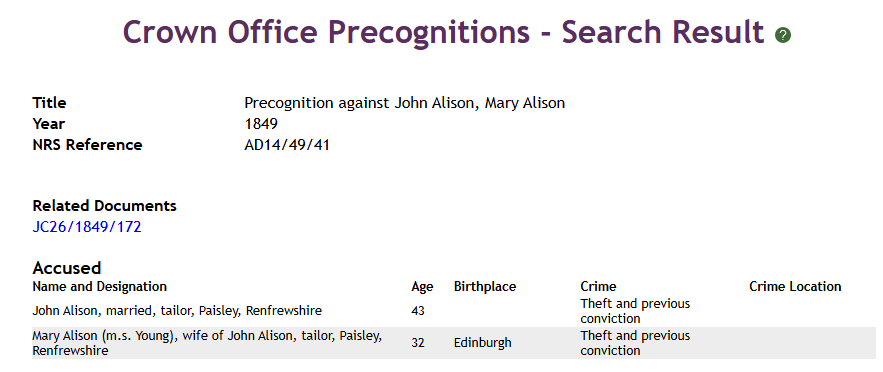
In a very short time I got from the pawn-shop my coat, which had been very nicely remodelled by old Alison, but not so changed as to be beyond identification ; and were I to say what the twenty-four buttons produced, I might be accused of exaggeration. I can at least say that that button ofthe Assurance Company insured many a lobby against the risk of prowlers for a long time, and that, too, without the company getting a penny of premium; but what was more, that same button was the means of procuring for old Alison and his wife, as resetters, and young Jack, as the prowler and thief, sixty days of Bridewell, without the luxury of playing “ nievie nick-nack ” with his brother prowlers.
I may remark that the public are often under the belief that when a system of depredation has been carried on for a time, there are many hands employed at the work. It more often happens that they have all a centre in one or perhaps two individuals. I stopped the shutter-punching mania, as well as that of the bag snatching, by one capture in each case.

 James McLevy