I have never been able to ascertain where all those images of people go to in my mind. I am sure they are not packed up, each with its little film of card away back, the last got being always nearest the eye, like a barrel of herring on its side; for in that case I could not
get out some fifteen-year-old one, as I do so easily, to confront it with some of my children, who have been away round the world and come back again. Nay, the older they are the brighter they are, and then they don’t trouble me any more than if they were dead,—like the flies in Dr Franklin’s bottle of Madeira, I have read of somewhere,—and are always brought alive again just when they’re wanted. Neither do they trouble me, as they certainly do others, who have what they call a fancy, where the little things are eternally getting restive, rising up and flapping their wings, and flying hither and thither in confusion, bothering the soul, so that it becomes terrified at midnight with ghosts and phantoms, and producing hysterics, and Heaven knows what more. I have no fancy. If I had had, I would have been dead long ago; for how could I have borne such a host of thievish and xnurderiug-looking likenesses of banished or hanged men, rising up on me in myriads, and haunting me every- where, as ifI had banished or hanged them in spite of the innocence they all protest, and sometimes look so much like ? No! thank Heaven, I sleep, and have always slept, not like a top with its unobserved whirl, but like a log, And if I should be wakened, to catch some Bill Brash who has taken it into his head to come back from Norfolk Island, whither I had sent him, I find the image of Bill as ready at my call as if it had been fluttering and tormenting me all these seven years.
It is now a pretty old story, that of the lifting of two piles of valuable tweeds—worth a hundred guineas— from the door of Mr Young’s shop in the High Street. I got notice almost on the instant, and hastening down, saw how the affair had been managed. The glass door inside had been shut, and the piles had lain on either side of the space between the outer door and the inner. The affair looked curious. The piles were four feet high, and every web rolled on a pretty heavy piece of wood, so that it would have been a considerably tough job to have snatched even one and made off with it in the very heart of a passing multitude. The shopmen had, of
course, their theory, as all people in such circumstances have. There must have been, they thought, at least half-a-dozen about it, each taking a piece and running off with it, just as ants do their bags when they want to get them out of the sun. I knew better; such a scene would have been noticed outside, because the very succession of the liftings would have taken greatly more time than the pauses of passengers could have permitted.
In short, I saw that one person could do it better than a dozen, taking quietly, after a survey, first one web and then another, depositing in succession, and coming and going. Then there was the inevitable conclusion that the webs were not far off,—a great point; but the webs
were deposited, and would be where they were; so my case was not one of chase, and Time to be taken by the forelock.
Nor was I long in getting my theory confirmed. Just as I was inquiring up and down for a hint, I met a woman who said she had seen a young man turning the comer of Borthwick’s Close, with a piece of cloth under his arm.
“ One piece ?” said I. “Ay, ane,” replied she, a little groggy; “ and plenty, for, my faith, he was staggering wi’ the weight.” “ Do you know where he got it ? ”
“ No; but he looked as if he had come up the street, and what was I to think but just that he was a snip ? and then they aye walk quick, the snips, they’re so glad to get on their feet.”
“ They don’t stagger, though,” said I. “Sometimes on ‘little Sunday,’—that’s Monday,— for they’re aye a day or twa ahint the other workmen in their weekly jubilees.” I listened patiently, for I never repress witty witnesses; their conceit makes them say more than your
grave informants, who have no tickling inside their clay heads. “ Did you see enough of him to enable you to speak to his appearance ? ” I inquired again.
“ Only the hinder-end,” said she, with a groggy smirk, “ which is aye big in them. I could swear to the hinder-end o’ a snip, but no to a particular ane, for they’re a’ alike; the swivel, too, that maks them rock sae when they ’re in a hurry, is a’ o’ a piece; and then, they aye snuff with the right nostril, which they haud to a side, to save what they ’re sewing.”
And so on she would have gone,—for, as I have said, she had had a dram,—but I had got all she could tell, and, inquiring her name,I got onwith my thoughts. Could it, after all, be possible that this bold fellow had returned and returned to the treasury, and picked off twenty bales of goods all one by one ? The man that achieved this was worthy of my acquaintanceship, and even this consideration alone would have inspired me to a capture; but then, such an artist could scarcely have been unknown to me, unless he were a new importation, and that was unlikely, for he must have arranged his resetting-place, and have known the closes. On what I had got, my theory was formed. Going down to Hunter’s Square, I went south by Blair Street, till I came to the Cowgate, and then along to the foot of Borthwick’s Close; I then stepped into a grocer’s shop,—always the historical register-office of the neighbours, who can’t do without their penny candle, red herring, and ounce of tea.
“Any strangers about the close, Mr Heron?” said I.
“ I believe the turner’s son has come home,” he replied.
“ You mean by the turner, the old man whose shop is there, but who lives elsewhere?”
“Just so.”
“But Brash can’t live in the shop ? ” I rejoined. “Not sure, the father is weakly, and has not been working for some time.”
“And perhaps the son may sleep among the saw- dust ?”
“ Not unlikely. I’m sure, at least, he hangs about here, for I saw him lig-laggering wi’ the women opposite my window yesterday.” “But he has never bought any cheese, or herring, or
bread, or a candle, and taken it away as if to use them somewhere here about ? ”
“ Yes; he bought bread and herring yesterday,—no candle,—and he went up the close with them.” “ If he had been living with his father, he wouldn’t have come here.” “ No ; the family were never customers of mine.”
So far well enough. There was some one in that close, who, if my memory served me, was very well able, from experience, to do the bold and clever thing that had been done; but it was no business of mine to be seen thereabout just at the time when I wanted somebody, and when some other body might say to another body, that M’Levy was there, for the people had got into their heads that I could be nowhere but where I should be. I would rather, at that juncture—it was now getting late—be among the light-o’-loves. Really, in these very squeamish days I know not how to get rid of my old vocabulary; we used to have good sturdy names for a certain class,—not those of Mohammed’s paradise, with the black eyes they have at their heavenly birth, but those who have black eyes of another kind, generally given by one to another, and not just so productive of love. So I have been careful in avoiding slang,—a kind of language rather beneath me,—but then, certain names are useful, if not necessary. Were I a scholar, I might profit by example, such as that of one of our lieutenants, who said, perhaps not seriously, that they should be called, not w_______ s, but Vesuviennes, and their district the Lavoro; I think probably because lava is found there,—pretty hot to the touch, and apt to leave reddish marks, only curable by such gifted creatures as Mercury. Under whatever name you like, I was accordingly soon there, with a notion, not at all unjustified, that my tweed-lifter—like other people who have done a great feat and made a fortune—would, in place of going home and snoring out his triumph, go where “ pleasure waits him,” were it for no other purpose than just to give his relieved heart some play, or get some recompense for his trouble. And who that by his own hands had made £100 in half-an-hour, upon a capital of a bad shilling, would not feel happy, and inclined to be among merry people, like’ these black or blue-eyed damsels, always jovial, even in the very midst of their wretchedness and tears,—not Christ’s tears, alas! as the wine of my lieutenant’s Lavoro is called, they say, but of a hotter and bitterer kind ?
I was thus naturally led to Hyndford’s Close,—a very good specimen of a rut in a dried stream of lava, which, I fancy, is just a kind of cinders. I went through several establishments ; and last came to the great one, with nine or ten beds, if you can call by that name the four fir-posts, with the lath bottoms, and the pieces of yellow cotton sheets, and scarcely less yellow blankets, and strips of old carpets or horse-cloths spread over them, and the pillows,—little bags, sometimes filled with teased oakum, among which I have often found jewels and gold watches. In that house I once discovered as sharp a trick as ever I played, if it was not sharper than the discovery. I had traced a £20 watch to the pocket of “The Crow,” and there lost it just as she was supping her sheep’s-head broth out of a capacious bowl, with what they call a horn cutty. I searched about every- where and could not find the watch, yet I was certain it
was in that room. I had almost given up, when I noticed her very slow with her kail. I knew it wasn’t fear prevented her satisfying her appetite, for “The Crow” feared me no more than she did her mother, whom she was in the habit of thrashing, because, as she said, the old woman had taught her her trade. There must be some secret under this sudden want of appetite.
The kail would not go down in the bowl, because she would not put them down into her stomach. I suddenly caught a thought. “ Let me taste your kail, Bess; ” and my first sup was of the watch, which she had slipped into the bowl when she saw me enter. When she took flight to the South Sea, I would have taken a year from her banishment for her magpie trick, Crow as she
was.
I need not say how vain it is to question these queens of Rougedom1—another modern name—as to any gentlemen of the light-fingered tribe being among their subjects, —unless you are to go direct contrary to their contraries,—nor with what confidence they lie in your face as they hold up their queenly countenances. They are all of a piece, these queens, and a strange piece indeed. You may know every section by mark,—the purpleface, always with a rotten-like tumefaction about it, set on the thick bull neck, which again is set on the bundle of flabby stuff she calls her bosom, which again is just the top of a sack-like heap of undulating matter, swelling out here and there as she moves, all surmounted with the sleazy mutch, set off with a crop of faded French flowers, collected from her subjects. And there is pride in this corporation, as she looks big, talking of “ my house,” sometimes, at least once in my experience, “my establishment,” “my young ladies;” sometimes these one day without a shoe, and the next (a pawn redemption-day) decked out with articles every one of which has its eventful history; how it belonged to some fine lady in Moray Place,—how it came down to the lady’s maid,—how it
ran the gauntlet of passing turn about among the house- hold, with a dogging envy of its possessor for the hour, —how it had charmed a “ colley ” from George Square to Hyndford’s Close, where he lost his watch,—how it has been pawned a hundred times, and yet retained its power of drawing.
Even with so proud a dame I seldom did more than give her a nod, as I opened the door and took my walk, as I did now among the beds and cells. I searched everywhere,—all the working bees out among “the flowers of Edinburgh ” to bring home the honey in the shape of money,—but there was, far ben, with a window looking into a ruinous area to the east, a room I remember very well, and the door of which I had passed. I retutned to enter, but found it shut, and locked inside.
These crazy hindrances I have often made short work of, by putting my back to them, in obedience to which they generally fly open, with the advantage of anticipating the preparation the inmates honour me with. I applied that force-key now, for I knew that any suspected de- nizen of that inside heaven would rather jump the window for the opposite place than welcome me to his bower of bliss. A gas-burner was flaring away right in the faces of three persons, two women and a man. I saw nothing, of course, but the three faces, with the six eyes looking clear, but in nowise bewildered with anything like consternation, only the man did not seem easy in a
position which, judging from the apparent cosyness, he might have thought enviable by some whose tastes lie in that heavenward direction.
“ You seem to be very comfortable, my friend,” said I; “ I am sorry to flutter your wings in that paradise.” A growl repaid a handsome compliment; but such is the way of the angels in these paradises. “ I will thank you to get up,” said I. “ Don’t, Jim; he has no right,” said the guardian angel on the left.
“ Ay,” said the other on the right, “ what right have you to disturb decent people in their own apartments ? ”
“ Come, I say, get up; don’t you see I’m waiting ? ”
“ Shan’t,” growled the man; “ you’ve no charge against me. I came to Edinburgh only yesterday.”
“ Where from ? ”
“ Belfast.”
“ What street ? ”
“ Huntly Street.” “ No such street there, I suspect,” said I. “ Come, get up, and dress, and the ladies can cover their faces with their hands.”
“Won’t do, Bill,” whispered the left one; “it’s M’Levy; if anything’s wrong, it’s all up.”
“ So you won’t rise ? ” I persisted. “ What for ? ” roared the swain, getting at once into a rage, as he probably contrasted our cells with his present angel-guarded position. “ Just to don your clothes,” said I; “ I want to know if, by searching, you can find anything in the pockets which I may think curious in the arts ; but I have some delicacy in rifling pockets. There may be money in them, and you might charge me with a deficit. Come.”
“I never rifled pockets anyhow,” said he, as he fixed his eyes on me, with a look that did not change my conviction that I had had his image for a good many years in my mind, associated with the honours offered to him by a judge, and a jury, and a full court, before he sailed for Norfolk Island. Yes, even though thus translated, with the light of his sister angels shining on him, I knew him the moment I threw my eyes over him.
“ Well,” he cried at length, as he started, and stood before me, yet, I thought, under the belief that I did not recognise him. “ Quick and cover; here’s your breeches. I will be your footman; here’s the vest, and next the coat, stockings, neckcloth, boots,”—all in succession, with proper intervals. “ All right; now you are in a position to appear before the ladies.” “ What next ?” said he, sneeringly. “ Ripe, and tell me what is in your pockets.” “ There’s a handkerchief,” said he, pulling out, “ a penknife, a quid of tobacco, a pipe, a bit cheese, an empty phial,—that’s all. Does any one of them belong to you ? ”
“ Nothing more ? ” said I. “ Try again. I thought I heard the phial strike against a bit of steel, perhaps a key. Come, out with it; I am curious in keys.” But he wouldn’t.
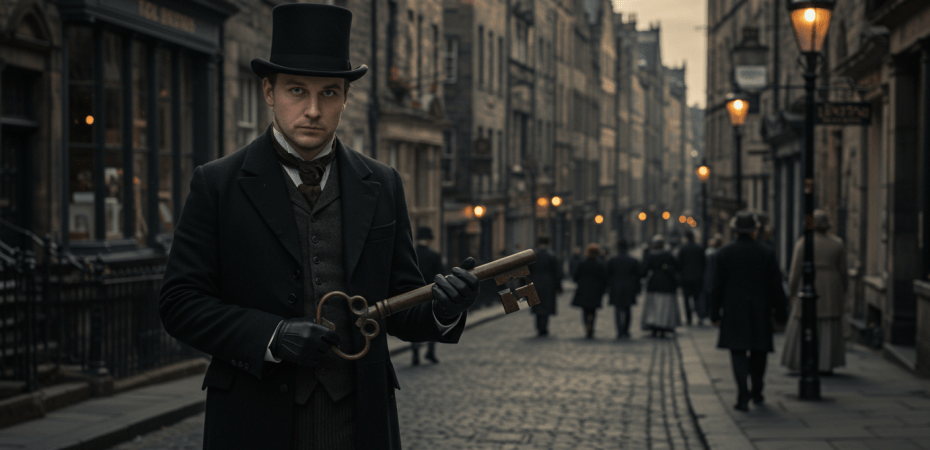
“ I ’ll help you, my good fellow,” said I; “ you know I’m your flunkey.” And plunging my hand into the right outside-pocket of his coat, I brought out a good-sized outer-door key. “ Where’s the door that key opens ? ” asked I.
“ In Belfast.” “ Belfast again, and in Huntly Street! No doubt the house will have a number too—10,060 ? ”
“No. 11.”
“ Well, we shall go there to-night,” said I. “Are you ready ? ” And not waiting for a reply I took him gently by the arm, and moved him out. The inevitable all-up was now in the ascendancy, and he went like a lamb till we got to the High Street, where I gave him in charge to
my assistant, there waiting. I had the key in my hand; and, coming to Borthwick’s Close, “ This way,” said I; “ I have a call to make before setting out for Belfast.”
Nor did I take any notice of the change that, like a flash, came over his countenance. He was a ruddy, healthy fellow, new from a voyage, and had not yet taken on the close-colour, but he was in an instant pale enough to satisfy even Despair herself. Proceeding down the close, my man and assistant before me, we came to the turner’s shop.
“ I want to go in here,” said I. “ I have nothing to do with that place,” said he;
“ this is not Huntly Street, Belfast.”
“No, nor No. 11; but just you open the door,” (handing him the key,) “ and let me in.” Though the key seemed to burn his fingers, he was yet so satisfied of the all-up necessity, that he seemed to grasp it nervously, and proceeded with his own hand to open the door.
It was much too dark to see into the hole, but there was light in an opposite window ; and getting, upon a rap, the end of a halfpenny candle, I came over. “ I want to see,” said I, “whether this turning-lathe turns out any tweeds.” And straightway our eyes beheld all the webs of
Mr Young’s two piles of cloth, built neatly up against the wall. I counted them carefully, for I had a pride in the exact number—thirty pieces, all there, not one wanting. “ You can identify these, Mr William Brash,” said I, looking my prisoner directly in the face, “ as the webs of cloth you stole from Mr Young’s shop-door some four hours ago ? ”
“Brash is not my name.” “Not now, but it was before you went on your travels; for which jaunt you were indebted to me, I rather think.” His courage couldn’t stand my last appeal, and he
seemed as well satisfied that I could do no more for him as any one with a cancer could be with the doctor who administered a hemlock poultice, which could nip, but never heal.
Having taken him to the office, and provided for him carefully, as a valuable addition to our stock of moral curiosities, I got the thirty bales up, -which were all safely delivered to Mr Young; but that gentleman, I rather think, had no less difficulty in accounting for the seizure, so near his premises, than in understanding how these thirty heavy webs could have been carried away, in so short a time, by one man. That there were no assistants, was admitted by Brash himself, who was sent abroad a second time for ten years.
- Rougedom – the world of prostitutes ↩︎
 James McLevy