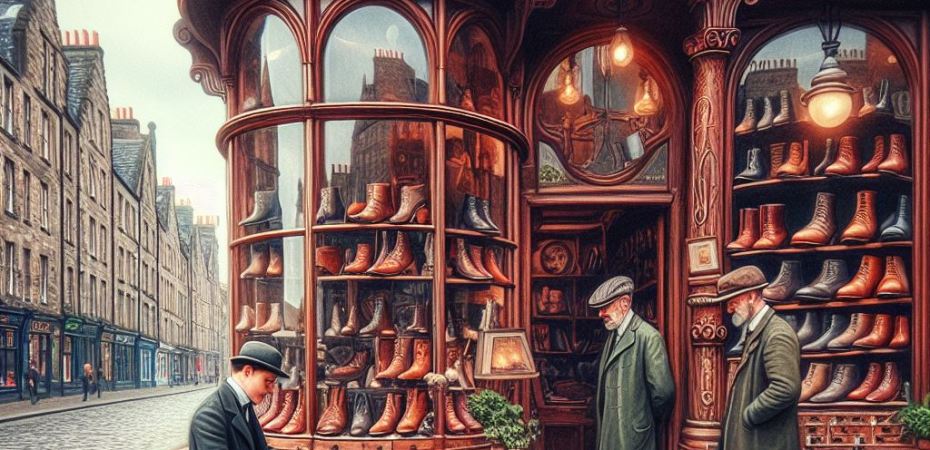
One morning, in the year 183—, information was sent to the office that a shoemaker’s shop in the West Port had been broken open, and a quantity of new boots carried off. I got the intelligence, and having been always impressed, as I have said, with the conviction that in all such cases, an hour at the beginning is worth a whole day afterwards, I hurried down to examine the shop, and have a few words with the man. On looking about, I ascertained that the robber or robbers had been wonderfully moderate in their depredations, after having been at so much trouble. Only a few pairs had been taken away, and, as it were, picked out pretty deliberately. Then, why at so much trouble with so humble a shop, when so many larger ones, containing valuables, might have been entered, with perhaps less manipulation, and with a hundred times more booty? I at once fell on the suspicion that some one acquainted with the shop was the depredator; and, moreover, that he was single-handed—altogether upon his own hook, as we say. On this supposition, I questioned the shoemaker back and fore, and he soon began to see that some one of his own people must have done the deed. Nor was it much longer till he singled out a discharged workman, who had come to him as a kind of tramp from Glasgow. “ His name ?” asked I.
“John G .”
“ Is he presently employed?”
“ No, he is going about idle.” “ Did he ever hint of any intention of going back to Glasgow i” “ No, he told me in the shop here that he was going to Inverness.” “What brought him to the shop ? Had he any other thing to say than that he was going to Inverness ?”
“ Now, when you set me a-thinking,” replied the shoe-maker, “ he had nothing else to say.” “ And therefore he came just to say that,” I muttered, giving expression rather to my own thoughts than wishing to enlighten the shoemaker.
I did not see that I could get any more, nor was I dissatisfied with the mere fact that the peripatetic snab had been at the trouble, before supplying himself with more boots than he could wear the soles of in his journey, to make this kind communication to his old
master. Thieves and robbers are great speakers by contraries, so that were you to follow them round the world, you would meet them mid-way about the Cape of Good
Hope at that moment when you had no hope. They use an easy cipher, which we have only to turn upside down; but it is not that you must seek them south when they have sworn they are on the tramp for the north,—you must often expect them at “ Loch Drunkie1,” in Perthshire, when they have been bent on drinking the sober waters of the crystal “ Ninewells of Berwickshire,—one well not being enough for the demands of what Dr Miller2 calls—so obscurely to simple people like me—their nephalism3, which I have detected means no more than just temperance or sobriety. I must get my snab with the boots anyhow; and it was clear I could get no further help from the master. On leaving the shop, I went direct to Princes Street,— of course with an idea in my mind, and somehow I have always been contented with one idea when I could not get another; and the advantage of sticking by one is, that the other don’t jostle it and turn you about in a circle when you should go in a straight line. My line
was accordingly straight enough, but not to Inverness.
I went west, intending to question some people at the Hay-weights as to what kind of folks had passed about that early hour in the morning when even the most passable-looking gentry on the stravaig are kenspeckled.
I suspected he would have a bag; and a man with a bag on his back at gray dawn does not usually carry it as an offering of faggots to the rising sun; and then a bag has a mystery about it even to those who never saw Burke with his. On going forward I met a man who had clearly come along the Glasgow road—even a better customer than those at the Hay-weights : at least I never yet encountered a traveller on a solitary road who was not able to tell me something about the wayfarers he has met on his way,—nay, though they belong to the inferior tribes, he will notice whether it is a Brownie ot a Hawkie, so curious are people about common objects when they have nothing uncommon to occupy their minds. “ How far have you come ? ” said I. “ About ten miles,” replied my man; “ and the deil clip them short, for I’m tired, and my boots are clean worn through.”
“ And what is that you are carrying ? ” said I, with that unavoidable curiosity that belongs to us. “ Just a pair o’ thae same things,” replied he; “I got them cheap for five shillings frae a pedlar, about twa miles on.” “ Let me see them,” said I.
“ Weel, I didna steal them ony way, and ye ’re welcome,” he said, as he undid the paper, and shewed me a pair of boots, with my West Port customer’s name stamped upon them. A cab at this moment came up. “ Ho, there ! ” I cried to the cabman, who drew up; and, turning to my friend, “ You’ll just step in, and ride a bit with me. I want to speak to you a little about the boots.” “ The boots ! ” said the man, as he obeyed me almost mechanically, perhaps as much through fear as a kind of notion he had that I was to drive him into town ; but when he heard me tell the driver to go on at a gallop along the Glasgow Road, and found himself carried along
at so hard a pace, he cried out, “ Lor’, man, this is my road hame again, and it’s to Edinburgh I am bound ! ”
“ “Well, well,” replied I, “ you ’ll be in Edinburgh by and by ; but I am curious about the boots. They are so good and so cheap that I would like to get a pair from the same pedlar, and I’ll just take you with me to help me to bargain for as cheap a pair to myself.” “ The deil’s in you for a queer chield,” he replied, in
amazement; “ but this is ae way and a half to buy a
pair of boots. I canna gang—stop there ! ”
“Be quiet, sir,” said I, shewing him my baton, the sight of which calmed him in a moment. “Drive on.”Nor did my astonished friend speak a word more for several minutes, confounded as he was with his new position. The driver, who knew me, kept his whip in a whirl, and our speed rather increased than diminished, till we got beyond Corstorphine, when my companion shooting out a long neck,— “ Yonder he is,” cried he.
“ Stop,” said I to the driver, “ when you get up to a man with a bag.” Nor were we very many minutes when the cab stopped, and my snab4—for it was the very man—stopped also to
see what was to turn up. A moment satisfied him that he and his bag were the cause of all this trouble, though I am not sure if he knew me, only the sight of his customer probably told him that he had been informed on bv the ungrateful wretch he had favoured with so good
a bargain. In a moment, the bag was thrown off his back, and he was off at only a cobbler’s pace.
“No use, my friend,” I cried, making after him; “ I want a pair of boots of you.” And seizing him, I brought him back to where the bag lay.
“Open it,” said I, “ and let me see your stock. You sold this man a pair at five shillings, and why not favour me?” Even through his suspicion and doggedness there gleamed a small light of hope in his eye, and having opened the bag and shewn the boots,— “Oh, I’ll take them altogether,” said I, “and this man’s pair to the bargain.” And throwing the bag—into which I placed also the countryman’s pair—into the cab, I put him up too,
by which time he knew that he was fairly caught, and became very quiet. “ To Edinburgh, again.” On arriving at the place where I took up the country-man, I set him down.
“ And now, sir,” said I to my prisoner, “ you pay this poor man his five shillings, and I’ll pay you for the whole stock when I get to the High Street.”
The five shillings were reluctantly told out. The countryman was overjoyed beyond measure, and I took Mr Snab to the office. The shoemaker got back his boots, and my friend six months in a place where a pair would have lasted him, if they had been lasted by so cunning a hand as his own, for six years
- Loch Drunkie – a small freshwater loch in the Trossachs near Aberfoyle ↩︎
- James Miller wrote the book Nephalism,the True Temperance of Scripture, Science and Experience ↩︎
- Nephalism – the practice of abstaining completely from the drinking of alcohol; ↩︎
- snab – a cobbler or cobbler’s apprentice ↩︎
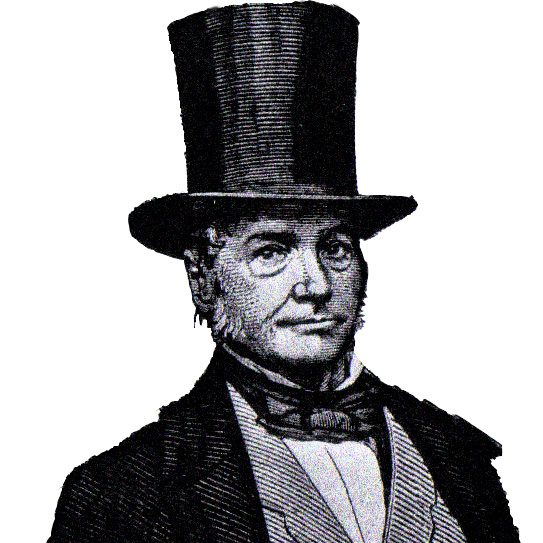
 James McLevy