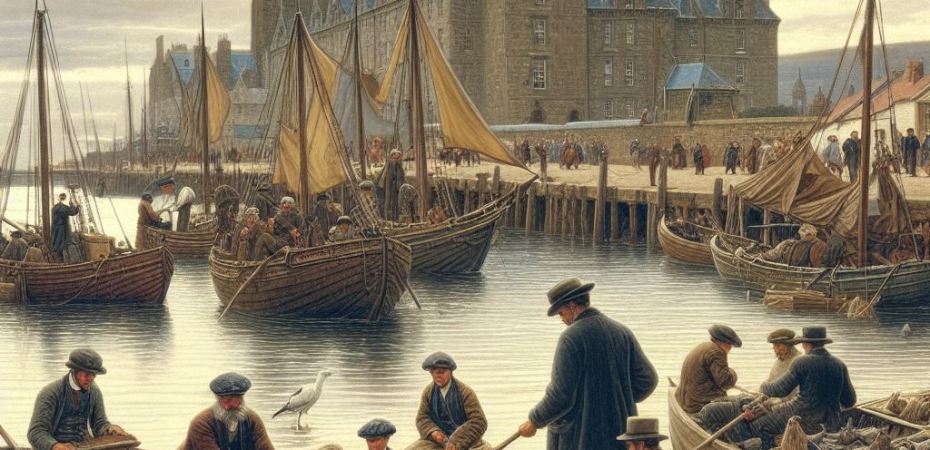
I have heard it said that the clue of a man’s destiny lies at the foot of his cradle. I don’t pretend to understand this saying very well, but I know there is a clue that leads somewhere; and that although there may appear to be a break in it now and then, I have noticed the junction, where there seemed, to common eyes, to be no connexion whatever. I have already given a good many cases where the peculiar traces that bind a lawbreaker to his crime were so minute, that it seemed impossible to discover them; and if they had not been discovered, the destiny of the man could not have been said to be connected with the act, so that God’s ways could not have been justified to man. But they were discovered, and hence our faith was confirmed. Of this kind of cases, no one ever struck me as being more curious than that I am about to narrate, though the thing stolen was not, any more than in some other cases, of very great pecuniary value. Some years ago, two or three young thieves were seen lurking about a house in Brandon Street, on a Saturday night. Their attention was directed to a front door, which no doubt they wished to be open. One was seen to go up and examine the checklock, and then come away and commune with his friends. Then there was a jingling of keys, as if they had been turning out their stock of skeletons to know which would fit. At length they succeeded: the old customer tried his hand again, the door was opened, and by and by the two who were on the watch outside got handed to them three topcoats, with which they made off, while the chief thief quietly shut the door and walked off. All this play was noticed by one who could neither run after them nor identify them; and when notice came to the office, we had absolutely nothing to go upon. Next morning (Sunday) Mr Wilson called the officers and gave them their commission. “ It is not the value of the coats,” he said, “ that makes me anxious about, this case, but the certainty I feel that if we don’t get hold of the thieves, our books will be filled with cases of the same kind. Now let us see who shall be the first to bring in the gentlemen and the coats. I need not say,” looking to me, “who I expect to be the man.” I had confidence enough, and although there was no clue, I believe I smiled at the compliment, just as if I had said, “Well, Lieutenant, they shall be with you in a very short time.” The truth is, that the theft was no sooner intimated, than my mind went away about Stockbridge, where I knew a covey of these wild- birds had alighted, and were picking up their food in the streets nearby; and my mind took this direction as a consequence of my experience that thefts by combination are generally traceable to a partnership which is as active while it lasts as it is short-lived. Nor are there many of these partnerships existing at a time,— sometimes only one, doing an amount of business, generally in the same line, which induces the good people to think the town is filled with robbers.I and my coadjutors went together, going, by my leading, along Fettes Row, and intending to make some forenoon calls at Stockbridge. We had emerged by the side of St Stephen’s Church, and just as we were on the eve of turning down by the front of it, I happened to cast my eye up Pitt Street, when my attention was arrested by two young men standing speaking to each other at the entry to the house and shop of a tailor in that street. One of the lads had his coat off, and I believe it was the white shirt-sleeves that first caught my eye.“A little in the wildgoose-chase way,” thought I, as I neared them,—“ going to catch feathersfrom a plucked bird.” Notwithstanding, I proceeded, and just as I got within their eye-shot,—my own was discharged farther down,—one of the two made off up Pitt Street, but not before I discovered he was no other than one of my suspected at Stockbridge. The coatless one slunk in, and, leaving him safe enough, I made off after the fugitive.I traced him to the turn of Heriot Row, and saw him running west at full speed. It was Sabbath morning, and it was not for a decent person like me to be pursuing thieves on the Lord’s day, though I was sure they were not running to church. So I turned my steps back to the tailor’s shop, where my white-sleeved gentleman was now likely completing his toilet, to appear as gay as possible in presence of his Sunday-out housemaid, who would be ready for him as usual, about the time when her mistress would be thinking her devout Jenny would be walking churchward, to the sound of the Sabbath-bells. On getting downstairs, I knocked at a door, and straightway there appeared before me my coatless customer, still uncoated and holding in his hand a big knife. The apparition startled me a little, but did not drive away my wits. I must get the knife out of his hand. He looked fierce, but that was no reason why I should not look the very opposite. “ Put on your coat,” said I, “ and come out and speak to me,”—a process he could not very well have gone through with the gully in his hand. Obedience to a soft request is natural, and my man, laying down the knife, with which, after all, he had perhaps been cutting his breakfast loaf, donned his coat, and came out to me, leaving the knife behind. “ Who was the lad you were speaking to a little ago at the door 1 ” inquired I. “ I was speaking to nobody,” replied he, with a very determined air,—a denial which resolved me at once. How much more I have often drawn out of a denial, where the denied fact was clear, than I ever did out of an affirmation, though clenched with an oath ! “ Now,” said I, in pursuance of a resolution which may appear unauthorised, if not foolhardy, but which I took my risk of,—for with me it has always been “no risk, no reward,”—“ you take your hat, while I keep hold of you,” remembering the knife, “ and then I will take you where you may get some help to your memory.” And having kept hold of him till he was covered, I took him up the outside stair and committed him to one of my brethren, who quietly led him up to the office. Having despatched this worthy, I kept watch at the door until the officer returned, then betook myself to examine the nest from which I had taken my bird. At the foot of the stair I met an old man, the master of the youth, and, as I afterwards learned, his uncle. Though he had not formerly appeared, he had heard enough to satisfy him of what had been doing, and was clearly prepared for me. “Though you have not often customers on Sunday morning,” said I, “ I have a commission for three topcoats, and want them upon the instant.” “I sell nothing on the Lord’s day,” replied my devout gentleman; “ neither do I work on that day.” “ But you are not forbidden to answer a plain question on that day,” I rejoined; “ and I ask you if you have about you three topcoats; and as you don’t traffic to- day, I shall take them from you for nothing, to relieve your conscience.” “I have nothing of the kind,” sulkily; “do you take me for a thief?” “ Not just yet,” said I; “ but wait there a little, and perhaps I may do you that favour when I come upstairs.” And without waiting for an answer, I shot down a very tempting inner stair, leading to an underground kitchen at the bottom, and below the back of which, where there was a recess, I found the very things I was in search of. In all which proceedings, though there was a dash of haphazard, there were not wanting probabilities, which were at least sufficient to move me, and in the following of which I was thus rewarded. “ I will take you for a thief now,” said I, as I came up the stair with the three coats over my arm. “ Though you could not sell clothes on the Lord’s day to a man, V. you could sell yourself to the devil by telling me a lie. These are the coats.” “ Oh, they will be my nephew’s, John Anderson,” he cried. “No matter, they have been found in your house, and you go with me.” And the devout little old man was so far cured of his devotion, that he neither preached nor prayed, probably because he had not a willing audience, and hypocrisy loses its cant before justice. He went quietly to where his nephew was; and now it was necessary to catch the other birds, who I suspected were those who brought the prey home. There was no difficulty about them; William Ferguson I had seen in the morning talking to Anderson; we got him on the same night at the house of his father. But there was another spoken to by John Anderson, as having been actively engaged in the robbery,—the brother of William Ferguson, called John. I had always such a desire to see my friends together, that it vexed me when any one was absent from a meeting, where the sympathy was generally so complete, that no one contradicted another, but all were bound together in the bonds of friendship, rendered tighter by a cause of common interest. If I had got none of the others, I would probably have been less solicitous about John; but John I must get, or my peace was not of that kind which consistsin duty done. There was a difficulty about this John. I had never seen him, neither had any of my detective brethren; and that he had made a desperate bolt, there could be no doubt, having in all likelihood heard of the capture of Anderson in the fore-part of the day. Another officer considered he had got a string in the direction of Leith, because he had heard at the house of the father that they had friends in that quarter. I did not try to turn his nose, seeing he was holding it out so snuffingly in that direction, and accordingly allowed him to run on, with the only fear that the organ would stick in the earth, before he got to the burrow, so keen was he in testing the ground traces; so away he went. As for myself, I had another notion. I have often found that Edinburgh thieves, when disturbed in their sweet security, make, like the deer, for the water,—not to swim, and distribute their peculiar odour in the fluid, but as a means to get away. And Fife is often the destination. Somehow they think policemen don’t cross waters,—loving rather to search on dry land, after the manner of the bloodhounds, which are always at fault in lochs and streams. At any rate on this occasion, it came into my head that my friend John would make for Newhaven early in the following morning, to catch the steamer that then plied from that pier to Burntisland. So on Monday I got up before daybreak, or rather in the perfect darkness of the prior night not yet modified, and having dressed myself, I took my dreary way to the old fishing village. The day was beginning to break when I arrived at the pier, where I took my seat on the edge of one of the hauled-up boats. The fishermen had been down to the Isle of May, and having arrived with five or six cargoes of fish during the night, were all ready, in their thick pea-jackets, long boots, and red nightcaps, for the fish fair which is held on the pier almost every morning during the fishing season. The regular fishwomen were beginning to come down from the village, with their peculiar dress,—the loads of petti- jjeats, of their favourite colours, yellow or red-striped, with the indispensable pea-coat, and close mutch enclosed in a napkin. Then there came the crowds of the Edinburgh fish-hawkers, almost all young Irish hizzies, resonant of oaths, and each with the hurly, without which she could do nothing in her wandering trade. By and by, the crowd, and noise, and hubbub increased to those of a regular fair; nor, amidst all the picturesqueness of the scene, was the indispensable fun wanting,—of such a piebald kind, too, with no similitude in the traits of the Irish jokes and the regular fish- wives’ Scotch humour,—yet with gradations of caste pervading the masses, the stately Newhaven dames appearing like grandees among the tattered callets of the High Street, and the demure and mute fishermen over- topping all, and only condescending to smile at times as some witty exclamation burst upon their ears. And there was I, sitting in the midst of this at six o’clock in the morning, looking for a young man I had never seen, and had only got described to me by an accomplice, who might have given me a lying portrait. What hope could I have of his being there, or of recognising him if he came ? Not much; and yet enough, for the crowd being almost all women, I could devote my attention easily to a newcomer. The boat to Fife could be seen coming over the Firth on her way to Granton Pier, whence she would come to Newhaven, thence to start on her passage across. I was meanwhile busy enjoying the scene before me, not a little amused by the remarks of some of my High Street children, who knew me well enough, if more than one had not been through my hands. It was now their turn for revenge— “ Och, woman, the thieves are so scarce in Edinburgh, he ’ll be to catch baddies this morning ! ” “Ay,he’ll to be handcuff the John Dories 1with a string.” “ And maybe tak’ them up to Haddie’s ” (Haddo’s) Hole, woman.” All which, and much more, I bore with good temper, the more by token I saw a young man coming sauntering down through the crowd, whose appearance claimed my special attention. He was very like the description given me by Anderson; yet my marks were so dubious, I could draw no very satisfactory conclusion. He paid no attention to the scene about him, and was clearly bent for the other side of the Firth, but he had no bundle, and had all the appearance of being on the “ tramp,”—not, however, as a tradesman on the search for work, but rather carrying to me the well-known aspect of one of our Edinburgh scamps, seedy, haggard enough, and clearly out-o’-sorts. He passed me as he went down, but the light of the morning was yet so hazy, that I required a nearer view. I rose from my seat, and followed him down the pier, getting as close to him as I could, with a view to a better comparison of his face with the image I had formed of him from Anderson’s account. While thus examining him, I observed on his coat some hay-seeds. “That lad,” thought I, “ has had hay for his sheets and I then recollected that, in the gray dawn, I had observed a large hay-stalk on the right side of the road coming down from Edinburgh. Slight as the suggestion was, I felt myself certain that he had been sleeping in that hay-stack all night; and no one will betake himself to a bed of that kind without some motive of concealment or refuge. At least if he was not my John, he ought to have been; and every look, after the view of the seeds, seemed to send a back energy down through my arm, imparting something like a crave in the fingers to lay hold of him; but then I -was among a crew of fishwomen, who would have proved troublesome to me, from recollections of kindness received from me, either by themselves or some of their friends; and I required to have recourse to tact. So, going up to him carelessly,— “ Raw morning, my man.” “ Ay,” with some confidence, almost enough to shake the hay-seeds out of my mind. “ You ’ll be for Fife, I fancy? ”
“ Right,” replied he; “ when will the boat be here ? ” “ You’ll see her near Granton, yonder; she’ll be here in a quarter of an hour. , We have time for a dram to keep the sea-air out of our empty stomachs.” And what eye that has been closed on a bed of hay in a raw night would not leap at the cheerful word “ dram ?” And so did his. Cold and breakfastless, he jumped at the offer. “ Come up to Wilson’s,” said I, “ and I ’ll stand your glass besides my own.” And thus I managed him, for he had no notion but that I was an intended fellow-passenger. In two minutes after I had him seated in Wilson’s, with the gill of whisky before us. “ Come, my lad,” said I,—for truly I had some pity for him, so cold and heartless he looked,—“ you will be the better for this.” And giving him his dram, and taking my own, of which I stood in some need as well— “ Are you from Edinburgh ?” But here he faltered for the first time, even with the reviving whisky scarcely down his throat. “ No; Cramond,” said he, irresolutely. And yet, if I was not mistaken, he came down the pier by the Fishermen’s Square. I was now getting confidence, and he was not losing it. So I beat up my advantage, for I had no authority yet to take out my leather strap. “ It is strange how friends meet,” said I, cheerfully. “ I did not think that Jack Ferguson would have forgot an old fellow-workman.” “ Well, I don’t remember you,” said he, without a protest against my soft impeachment. It is said that omission is not commission; a proverb not altogether true, I suspect, for here was just as good an admission that his name was John Ferguson as I could have wished in the very ardour of a search. “ And how is Bill, your brother V said I, without telling him that I had lodged the said Bill in safe quarters on the previous night. “ Oh, well enough,” he replied; and yet just with a trace of repentance that he had said it. “ Yes,” said I, now perfectly sure of my man; “ he is well enough, for he’s in prison waiting for you, as his accomplice in a robbery of three coats, in Brandon Street, on Saturday night.” The words were not out when he started up, as if a cannon had been fired close by his ear, and made for the door. “ Come,” said I, laying hold of him; “ you can make nothing by flight in this thoroughfare; you may as well be easy. Here’s a drop of whisky in the stoup yet. Take it kindly, and then I will fit you with these,” taking out my cuffs. And such is the accommodating spirit of these fellows, —so intimate with reverses, and mixing sin and sorrow with indulgence and indifference,—that Jack sat quietly down, and taking up the stoup, poured out the remaining half-glass, took it off, and then took on his curb. “Well now, Jack,” said I, for I was curious on a point, “didn’t you sleep all night in the haystack up yonder, on this side of Bellfield ?” “ Yes, I did,” he replied; “ how do you know that ?” “ Why, by these hay-seeds on your jacket,” said I. “ Don’t you see that if you had had these upon you last night before going to bed, and had taken off and put on your coat, as honest men do, these seeds would have been shaken off? and then, don’t you further see, it was very unlikely you could have got these seeds upon you this morning, when newly out of bed ? So, Jack,” I continued, “ it was really by seeing these very small particles upon you that I was led to the thought—for I was not sure about you—that you were skulking for some cause, and, therefore, very likely, one of my friends.” “ Good God ! is it possible ? ” he cried; as if he had been on the instant made aware of something he had not thought of before. “ Yes,” said I, “ it is possible and real. It is not I who am The Thief-catcher and as I pronounced the words I pointed my finger to the roof, and looked in the same direction, with a solemnity I really at the moment felt. Nor was the effect less apparent upon the face of the struck youth. A tremor seemed to shake his heart, and I thought I observed a moisture in his eye, which had so often and so long no doubt been red and dry with the effects of his outlawed and dissipated life. “ Yes,” he said, “ there is another thief-catcher higher than you, and I feel His hand upon me with a firmer grip than that of these cuffs. I will, if God spare me, be a different man. I will confess the robbery. Yes, I will convict myself and Anderson, ay and my brother, if they and my father should murder me for it; and if you don’t find me changed, my name is not Jack Ferguson.” “We may get you made a witness, and free you,” said I. “I don’t want,” he replied, resolutely; “I would rather be punished along with them, and, if I can get into their cells, I will try to get them to change their course of life.”
This was almost the only case of penitence in a confirmed thief I ever witnessed. In the same mood, I took him up to the office. It was afterwards arranged somehow that the devout little old man, the resetter, should be accepted as a witness, probably for the reason that he was less guilty than the others, though, in my opinion, he was the worst of the whole gang, let alone his hypocrisy, which only aggravated his resettership — a far greater crime than theft or robbery. They were tried by the Sheriff, and got, respectively, eight, six, and four months. Whether Jack wrought out his penitential fit, I never ascertained. He got out of my beat, and I sincerely hope into another, traversed by a better angel than a detective.
- John Dories – a distinctive type of fish with a black spot on its body ↩︎
 James McLevy