People who boast of a little courage are generally very averse from the cunning that skulks and gets behind screens and defenses; they can’t submit to such degradation; and therefore it is that when a man is found at this kind of deceit, he is set down as being a coward. I fear, however, that my courage would be pretty doubtful if it were measured in this way, for I have often enough been perdu in holes that would scarcely hold me, peering out for curiosities in my way, with much zest, and not at all ashamed when, bouncing out, I could catch a robber by the throat and bring him to justice.
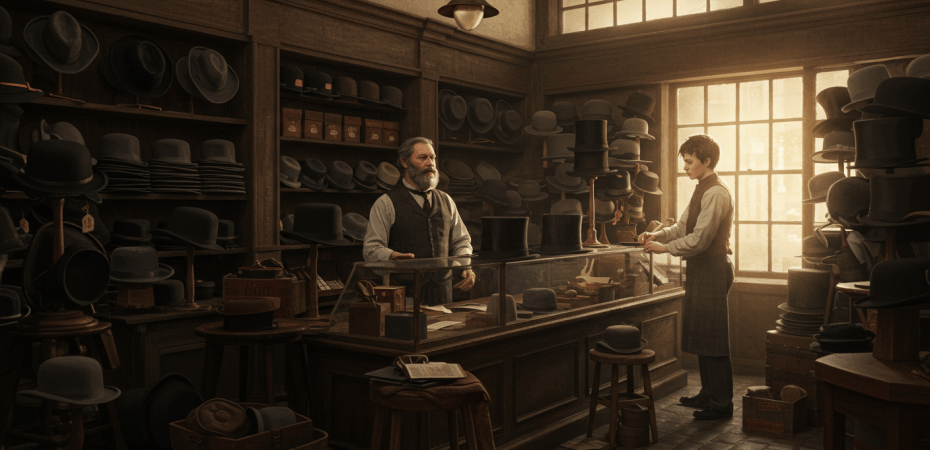
Some sixteen years ago, Mr. Tibbetts, hat-maker on the South Bridge, was greatly annoyed by that kind of disappearance of property over the counter which has no per contra of the appearance of cash. It is a common thing and speaks ill for the honesty of our people as well outside as inside the counter. In this instance, the affair was a puzzle; for while Mr. Tibbetts suspected his lad, there were disappearances that could not be accounted for by his dishonesty. Articles went amissing while the lad was there, but the same thing occurred when he was not there. He had tried many ways to get at the real truth but as yet had failed when he applied to me.
I went and examined the shop and got all the information I could get; very unsatisfactory it was. In some views, the lad seemed to be the thief, in others not; so that I saw nothing for it but a secret watch. I looked about me for a hiding place. Mr. Tibbetts recommended beneath the counter, where I might hear something but see nothing. I must have a look-out, but the difficulty was where to find it in an open shop, every corner of which was known to the lad, and where any screen or artificial covering would have been suspected in a moment. At length I fixed upon the recess behind the fanlight on the top of the door, where I could see all that took place in the shop, as well as take a look out on the street, if I chose to have a variety.
Of course, I had to be as careful in the one direction as the other, for verily it would have been a strange thing for M’Levy to have been seen doubled up behind a fanlight in a hatter’s shop, waiting for a victim. To render my look-out complete, I proposed that he should surround me with bandboxes, as the milliners’ apprentices are sometimes seen on the street. The notion pleased Mr. Tibbetts and was the more acceptable, as it had often been the custom to place hat-boxes there when there was no room for them elsewhere. Mr. Tibbetts was in the practice of opening the shop in the morning himself about eight o’clock, going home to breakfast at nine when he was relieved by the lad.
To make sure work of both suppositions,—as well that implicating the lad as that applicable to outsiders, whoever they might be,—I proposed to mount into my look-out, with my bandboxes about me, as soon as the shop was opened. Next morning at eight I was accordingly at the shop. I got up to my place by means of a ladder, and Mr. Tibbetts began his part by piling up before me the bandboxes, which, as he placed them, I arranged in such a way that I could see over the entire shop and yet not be seen by anyone who had no suspicion of my being there. All things being thus prepared, we took to our respective offices; occasionally, when no customer appeared, speaking of things in general, without my feeling much of that discomfort I had awarded to so many, viz., that of a prison; myself for once being a prisoner.
It is said that if every room of a house were seen into by a secret watcher, it would be a show-box even more wonderful than a traveling exhibition; and I rather think, from my experience, the remark is true. About half-past eight, a respectable-looking man, whose appearance was familiar to me, as going up and down the High Street, but whose name I did not know, came in.
“I want some hat-trimmings,” said he, giving the trade description, which I did not well understand.
Mr. Tibbetts showed him some specimens of hat-trimmings, but the customer appeared to me to be very ill to please, so that the suspicion got into my mind that the man had some other object in view than to get the article wanted; nor was I wrong.
“I must go upstairs for it,” said Mr. Tibbetts.
“Just so,” said I to myself; “and while you are upstairs, I will see what the very particular customer does.”
And I did see it. No sooner was Mr. Tibbetts mounted to the other storey, than the very particular customer swung himself over the counter, filled his outside pockets with trimmings—he was not now particular by any means—from a drawer; and then, vaulting over again, resumed his position.
“Ah,” thinks I again, “if you just knew that M’Levy is here, up in the fanlight recess, looking down upon you with these eyes!”
But he did not know it, and that was his comfort; and then, lo! all his particularity had vanished.
“Oh, just the thing.”
And, after all, the quantity he bought—no doubt of an old fashion he didn’t need—was so small in comparison with what he had in his big pockets, that the one, the smaller, might very well represent the amount of his real honesty; the other, the larger, standing for his assumed honesty or hypocrisy, whereby he cheated the public more effectually than he had done Mr. Tibbetts.
After he had gone, I shot my head over the bandboxes.
“What is that gentleman’s name, Mr. Tibbetts?”
“Taylor, a small manufacturer in the Canongate, and an honest man, I believe.”
“Very honest. Bring the ladder as quick as possible, and let me down.”
“What do you mean? That man surely did not steal anything?”
“I’ll tell you when I’m down. I never shoot secrets at people as if they were partridges.”
So he got the ladder and let me down.
“That man,” said I, “is off with trimmings of at least ten times the value of what he bought of you.”
“An old customer, ill to please,” said he. “Ah, I see now where my goods have gone; but why did you not tell me to stop him?”
“Just because I didn’t wish,” said I. “He will lead us himself to the store; and, besides, it’s close upon nine, and I don’t wish your shopman to see me, which he might have done if there had been a protracted bustle here.”
“Ah, I see,” replied he.
“I wait for you on the opposite side: join me when the lad relieves you.”
I took my new station, and by and by I saw the lad enter and relieve his master; who, coming out, walked on his own side towards the north. I then joined him.
“Taylor,” said I, “the moment you went upstairs, sprang the counter, filled his pockets, and again took the outside, and met you as like an honest man as the most other very honest men are like themselves.”
“You perfectly astonish me; though any man had sworn—”
“Yes, yes,” said I.
Just the old thing, which I hear rung in my ears every day, and which I have no need to repeat; because, really, I must proceed upon the cruel and very selfish principle of taking the greater part of people for rogues until they are proved by some test honest,—not that I think honest people are fewer than others say, but just that I have somehow a difficulty in taking their own word for it.
“And where are you going?” said Mr. Tibbetts.
“To Taylor’s house, to which you will please take me.”
“Why, I am almost ashamed to face the man,” said he.
“That is a feeling I never felt,” said I.
“I mean for the man,” said he.
“Ah, that is another question; that feeling I have often felt, and a very painful one it is.”
And so, under our necessity, we went to the house of our honest man, which we were not long in finding; neither were we long in discovering the goods. Laying my hand upon them, as they were yet warm as it were from the fevered hand of guilt—
“These were taken from Mr. Tibbetts’ shop within this half-hour,” said I.
The man, while betraying astonishment, did not quite lose his confidence.
“No man can say that,” he replied; “these are the goods I bought from Mr. Tibbetts. He went upstairs for them, and there being no one in the shop but myself, who could take it upon him to say that I stole them?”
“You don’t deny it,” said I; “you only assert that no one could see you.”
“Yes, I deny I stole them,” said he; “and, therefore, I conclude that, as there was not a single soul in the shop, you must have got your information second-hand, and that second-hand is a liar.”
“How can you be certain,” said I, “that no one saw you?”
“Because I have eyes,” said he. “I repeat, there was no one who could by any possibility see my movements, all honest as they were, in that shop. Did you, Mr. Tibbetts?”
“No, I was upstairs.”
“Then I repeat, and will stand to it for ever, that no one upon this earth saw me steal these trimmings.”
“Upon this earth,” said I, looking him in the face in that kind of way in which those eyes of mine, of which I am a little proud, have often enabled me to see things under the skin, and which, I am free to say, were never turned by another pair; “but there might have been one above who saw you.”
The statement struck him, but he recovered quickly.
“Are these your goods, Mr. Tibbetts?”
“Yes,” said he; “I looked my drawer,” (a circumstance I have forgotten to mention,) “and found as much as these amissing.”
“And, therefore,” rejoined Taylor, “you fix on me, though no one saw me steal them?”
“The one above excepted,” said I; “and by this authority, I ask you to step up with me to the Police-office.”
The evidence was too much for guilt, and he came away, I taking the trimmings along with me. He was duly lodged in safe quarters, to think on the value of what he had stolen, and compare it with the worth to him of a character.
The case was so clear that it needed little explanation. The fanlight recess, with its watcher and the visible theft, was more than sufficient proof, and Taylor was convicted at the next sitting of the court. His punishment was comparatively light, but his reputation suffered a blow from which it never recovered.
There is a moral in this story that extends beyond the mere detection of crime. Taylor, in his own mind, had possibly justified himself, as many do, by convincing himself that the goods he took were of little value or that his actions could not harm anyone significantly. But he had overlooked the principle that theft, no matter its scale or justification, is a breach of trust and honesty.
Mr. Tibbetts, on the other hand, was grateful for the recovery of his goods and, perhaps more importantly, the exposure of the truth. It also served as a warning to him and others in the business to be vigilant and not to judge solely by appearances.
As for me, this case was just another day’s work. But I could not help reflecting on the peculiar nature of crime and the even stranger nature of the human mind, which can simultaneously justify wrongdoing and yet be so thoroughly undone when caught.
My little adventure in the fanlight recess was not without its own amusement. The sight of the unsuspecting thief and the drama of his vault over the counter lingered in my memory, a reminder of the lengths to which people will go to satisfy their desires or cover their tracks.
For all its apparent triviality, this case reinforced my belief in the importance of even the smallest details in uncovering the truth. A single hidden watcher, a keen eye, and the willingness to persevere were all it took to unravel the mystery and bring justice to bear.
And so, life moved on, with its share of crimes and confessions, struggles and resolutions. As for Taylor, his story faded into the background of the city’s ever-turning wheel of events, a cautionary tale for those who might be tempted to follow in his footsteps.
 James McLevy