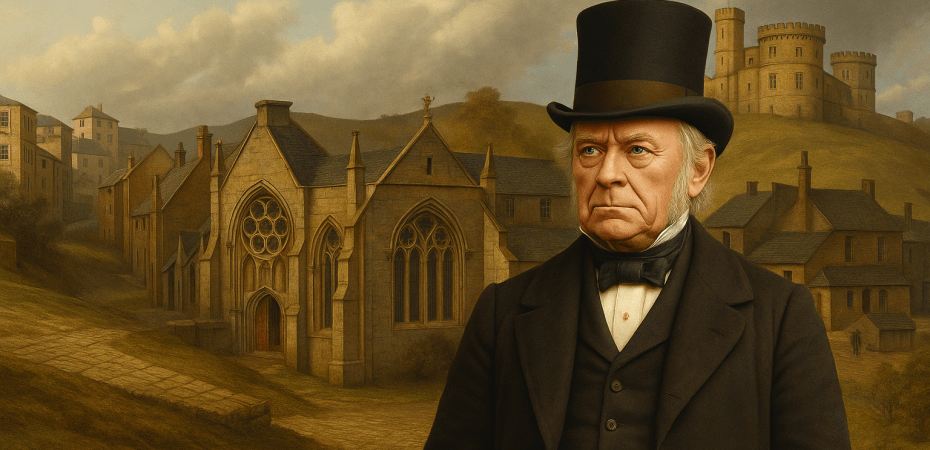

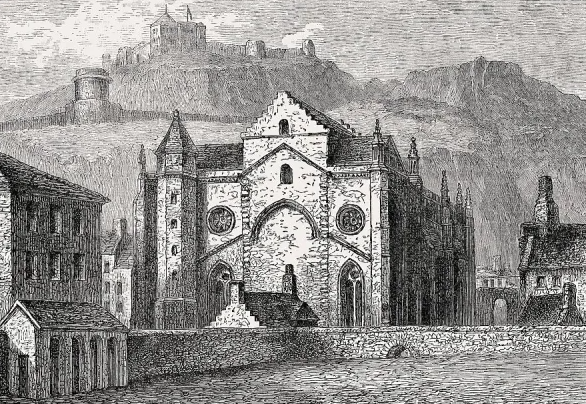
Tucked in at the foot of Leith Wynd once stood one of Scotland’s most splendid examples of medieval Gothic architecture: Trinity College Church. Though little remains of it today, its story is steeped in royal devotion, religious upheaval, and Victorian-era urban change.
A Queen’s Devotion
Trinity College Church was founded in 1460 by Mary of Guelders, widow of King James II of Scotland. Her vision was both personal and pious—a collegiate church established in memory of her husband, and part of a wider institution that included a hospital for the poor. It was a royal mausoleum as much as a place of worship, and it quickly became one of the most important religious buildings in the city.
A Gothic Masterpiece
Designed in the late Gothic style, the church was the work of master mason John Halkerston, whose skill can still be seen in other 15th-century Scottish buildings. Trinity College Church featured a long nave, lofty choir, graceful transepts, and a soaring spire—an imposing sight in medieval Edinburgh.

Reformation and Survival
The Scottish Reformation of 1560 swept away many Catholic institutions, but Trinity College Church survived, repurposed for Protestant worship. Its college and hospital were eventually dissolved, yet the building continued in religious use for centuries.
The Trinity Altarpiece
One of the church’s most significant artworks, the Trinity Altarpiece by Hugo van der Goes, was commissioned in the late 15th century. Remarkably, it survived the Reformation and is now housed in the Scottish National Gallery. The panels depict King James III, Queen Margaret of Denmark, and their son, the future James IV, in prayer, attended by saints.

(https://www.nationalgalleries.org/art-and-artists/17481)
Sacrificed for Progress
The church’s greatest threat came not from time, but from the march of progress. In the 1840s, plans were laid for the construction of Waverley Station, which would require the demolition of the church. Despite significant public protest, the building was dismantled in 1848, stone by stone, with the promise of reconstruction elsewhere.
A Delayed Resurrection
The stones were numbered and stored, but for decades, nothing was done. It wasn’t until 1872–77 that part of the church—the choir—was re-erected on Chalmers Close, just off Jeffrey Street. This new location gave a partial glimpse into the church’s former grandeur, but it was a mere fragment of the original.
Trinity Apse Today
Today, the reconstructed portion is known as the Trinity Apse. Though far smaller than the original, it serves as a poignant reminder of what was lost. Over the years, it has served a range of community purposes, from arts and crafts spaces to event venues.
A Legacy Not Forgotten
Trinity College Church may no longer dominate the Edinburgh skyline, but its story endures—in the stones of the apse, in historical memory, and in the very foundations of Waverley Station.



References
- See THE ECCLESIASTICAL ARCHITECTURE OF SCOTLAND p89, for details and drawings of Trinity College Church
 James McLevy