EDINBURGH POLICE COURT. Monday.—Before Sheriff Hallard.
IMPORTANT CASE OF CARD – PLAYING.
John Smyth O’Brien, residing in Parkside Street; William Flinn, residing in West Newington Place; David Wallace, and John Laing, alias M’Levy, both residing in North Richmond Street, were placed at the bar, on the charge that they, ‘all thimblers, or swindlers of a similar description, have been guilty of a violation of section 164 of the Edinburgh Police Act 1848, actors or actor or art and part, aggravated on the part of David Wallace, by his having been previously convicted of a similar offence, in so far as on the 13th February 1857, or about that time, in the house or shop situated in Spittal Street, and occupied by Robert Middlemass, publican there, they did all and each, or one or more of them, by fraudulent art or device, practised by means of fraudulently using cards, sleight of hand, or trick, cozen, or cheat Andrew May, residing at Clubiedean, out of L.20 or thereby, his property,’ &c.
Mr Scott, advocate, who appeared on behalf of the panels, asked for delay.
The Sheriff thought the evidence should be taken; and he would be ready to hear any objections which the learned gentleman might advance in support of delay which might thus arise. Evidence was then led.
Thomas Blackie, clerk in the Water Company’s office, spoke to having paid into the hands of Andrew May, on Friday last, in the company’s office, in Edinburgh, the sum of L.44, 16s. 3d.—L.20 of which was in one-pound notes.
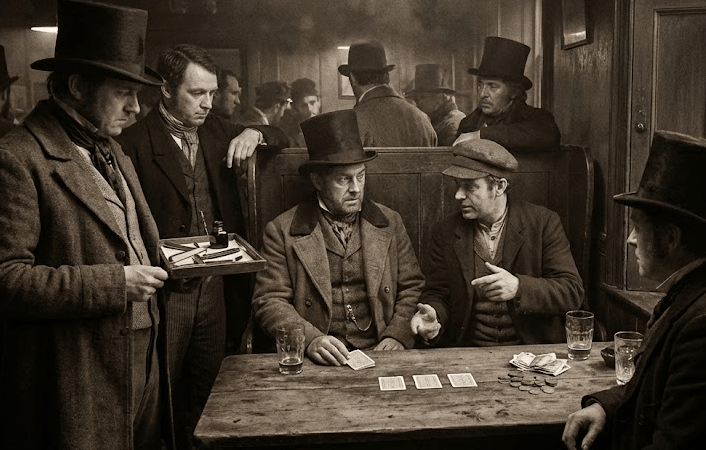
Andrew May said—I have charge of the Water Company’s banks at Clubiedean, in the parish of Currie. On Friday last I was in Edinburgh, and received at the company’s office, and for the purposes of the company, L.44, 16s. 3d. Twenty one-pound notes of this sum were in a bag by themselves, and the remainder of the money was in a separate parcel. After leaving the office, and while at the back of the Castle, on my way home, I met O’Brien, who asked me if I knew where one Henderson, a carpenter, lived. He said he was a stranger, and was a cattle dealer, and had newly come from Liverpool. I could not give him the information he wanted; but we both went along cracking, in the course of which I told him where I lived, and that I was going home to pay the men under my charge. When we came to Middlemass’s public-house, he proposed that we should go in and have a glass of ale. I consented; and O’Brien opened the door of a box, and showed me in. He then called for some ale, which he paid for. After a short time, Flinn and Wallace came in, and sat down in the box. After them followed M’Levy, who professed to be selling razors. He wanted to sell some, and also a small ink-bottle. O’Brien refused to buy either of the goods. M’Levy then took out three cards, and said he would play any of them for the ink-glass. After that there was a good deal of betting amongst the three who had come in. O’Brien did not play at first, and I sat looking on. They played for 2s. 6d., L.5, and L.10 successively. I saw plenty of money produced, but cannot say what sort it was.
It looked like gold money. They were handing it about, as if from loser to winner. I never saw the game before. O’Brien at last began to play, and as he had only a bank cheque for L.50 in his pocket, he wanted me to forward the money to him on the cheque. At last he whispered to me to bet on a card, the corner of which he turned up so that I might be able to pick it out. The card he marked was a red one. He advised me to bet on this card, and I would win L.20. I accordingly took out the bag containing the L.20, and counted them into O’Brien’s hand. M’Levy was using the cards at the time. He then shuffled the cards, and on pulling out the card which was turned up, and which should have been the winning one, I found that it was a black card, and not a red one. The corner of the red card had been knocked down, and the black one turned up in its place. They then told me that I had lost my money, which O’Brien gave to M’Levy. They then all left the public-house in a hurry, and had disappeared by the time I went to the door. I told the shopkeeper that I was done for life. While the card-playing had been going on, Mr Middlemass came into the box and forbade them to play in his house.
Cross examined—The game was to be won by me lifting up the turned-up card. After M’Levy had mixed them, they were laid down with their backs towards me, and I was to lift up what I considered to be the winning card.
Adam Gordon, a cattle drover, said he was in a box in Mr Middlemass’s public house on Friday, in which there were other five men. He was sure of Andrew May and William Flinn, but could not identify the others. They were playing at cards; and when one of them won L.1, May said it was capital, and he would bet L.20 himself. He produced a bag, and put it on the table. Mr Middlemass came in at that moment, and May put the bag into his pocket, but took it out again when Mr Middlemass went away. He seemed anxious to play. They had three cards, and the red was the winning one. May lifted a black one, and M’Levy took the L.20 and went away. Witness understood that May had lost the money. When May laid down his money M’Levy did the same. Could not say who was the stake-holder.
John Wight, a flesher, gave testimony to the same effect.
James M’Levie, criminal officer, apprehended the parties at the bar. M’Levy admitted, when apprehended, that he had won the L.20; O’Brien at first declined saying anything, but afterwards said that May was the man from whom they had won the money; Flinn said that he had got L.5 as his share of the L.20. He knew them all.
Michael Reilly, criminal officer, corroborated the above evidence.
Abijah Murray, sheriff-officer, said he knew O’Brien and M’Levy to be thimblers. O’Brien was convicted in December, for contravention of the Railway Act, by playing at cards in a railway carriage—This concluded the evidence.
Mr Scott then contended that card-playing was not always accompanied with fraud. It was a matter of skill, and there was no act against playing such games. He denied that it had been proved that the parties at the bar were swindlers, the evidence only going to show that they were held to be such by repute. It was not sufficient that the prosecutor should make out that they were swindlers by reputation, but how they were such in point of fact. He submitted that on this essential point in the statute the prosecution was an entire failure. Card-playing not being a game of swindling, its practisers could not therefore be held as swindlers. May seemed to have a dim notion that he had been cheated; but it was proven by the two drovers that he played with his own free will, and that he was most anxious to play. He had played with his employers’ money, and got himself into a difficult position, but his evidence would require to be taken with great caution. May himself was the only party who had used anything bearing even the semblance of a fraudulent device. He came off at a loss, just as he deserved; for it was just a species of diamond cut diamond. There was no necessity for calling in fraud to account for the defeat of May in the game; it was perfectly consistent without any such conclusion.
The Sheriff said he had an express statute before him, and the simple question was whether a contravention of that statute had been committed by the accused individuals; and he held the proof to be quite conclusive that such had been the case. After going over the evidence, the Sheriff said that it was necessary to prove that the parties at the bar had cheated May by some sort of device or trick; and the question, therefore, was, whether on the present occasion this had been done? Now, he maintained that this was proven, and that cards had been the means used for perpetrating the fraud. Upon the whole, he had no hesitation in convicting all the parties charged; and thereupon sentenced them each to sixty days’ imprisonment, with hard labour, and further, that they must restore the money, which they had obtained from May, under a penalty of sixty days’ additional imprisonment. The Sheriff, in closing the case, said that it was but justice to Mr Middlemass to mention that no blame could attach to him, seeing that he had done everything in his power to put a stop to the operations of the thimblers whenever these were notified to him.
We understand that the agent in this case has applied to the High Court of Justiciary for a vote of suspension and liberation, in behalf of the parties thus convicted. The Court meets to-day to consider the case.
The Edinburgh News Saturday February 21, 1857.
 James McLevy