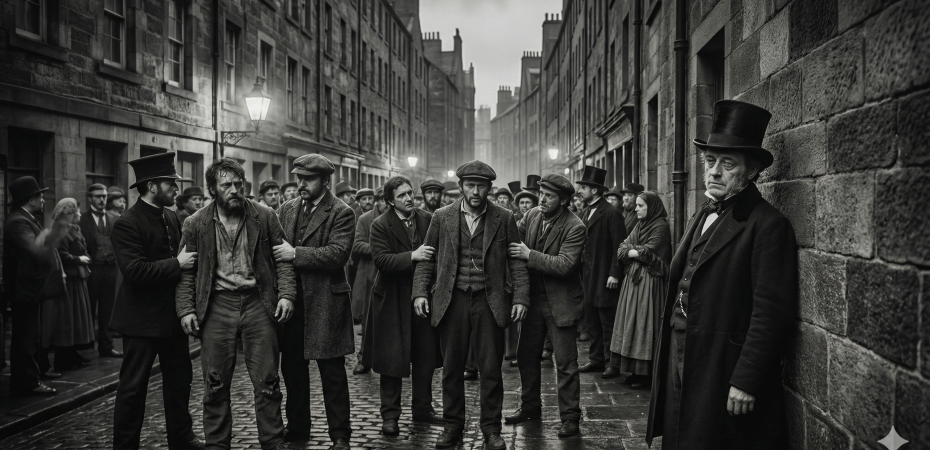
Peter Casey and James Murray were charged with kicking and striking Jeremiah Clark, in the Cowgate on Sabbath night, between nine and ten o’clock. The particulars of the assault brought out by the evidence adduced are as follows:—About half-past nine o’clock on the day mentioned, Jeremiah Clark, while entering from the Cowgate into the Horse Wynd, was struck by some parties standing on the street. They also abused him with their tongues, swearing at him, and asking if he was one of Mr M’Menamy’s men. He was then knocked down and kicked by some of the crowd. The prisoner Murray was identified as the party who had struck him at this time. Clark, anxious to escape from the ill-usage which he was receiving from the ruffians, went home as speedily as he possibly could. He went up the stair of the house in which he lived, and hearing a noise looked out at one of the staircase windows. He then observed Mr James M’Levy, a criminal officer, making gestures for him to come down to the street. A boy in the crowd ran up the stair and informed him that Mr M’Levy wished to speak to him. Clark accordingly came down, and M’Levy asked him to point out any of the men who had struck him. Before he was able to comply with this request, M’Levy was forced out of the crowd by Bernard Barker, a broker in the Cowgate. Clark, after proceeding a few yards in an opposite direction to the road taken by M’Levy, was assaulted by Casey, who, in the words of one of the witnesses, “put his foot before Clark and continued to hit him.” Clark soon after reached home, his face bleeding profusely and his eyes swollen and discoloured.
Mr Bernard Barker was examined in reference to his reason for taking M’Levy away. He stated that that officer was drunk, and was not capable of doing his duty. This was corroborated by M’Levy himself, who said that he had been in the country on Sabbath, and had drunk some wine. He had also been smoking, which had had a sickening effect upon him. He had not the least recollection of any of the occurrences said to have taken place in his presence in the Cowgate on Sabbath night.
The case was continued till Tuesday, to enable the prisoners to produce evidence in their behalf.
Terence M’Ginn stated that Murray and he had been in company on Sabbath evening, and parted between nine and ten o’clock.
Bailie FYFE said that the present case had received very great consideration. He found the charge completely proven against both prisoners, and he would sentence them to sixty days’ imprisonment.
Mr MOXEY read an extract from the police act relative to the power of the Court to dismiss or punish any officer who had failed in performing his duty.
Bailie FYFE said that he did not think M’Levy’s conduct sufficiently bad to warrant his dismissal. He would leave him in the hands of the superintendent.
Edinburgh News, Saturday June 22nd 1850
 James McLevy