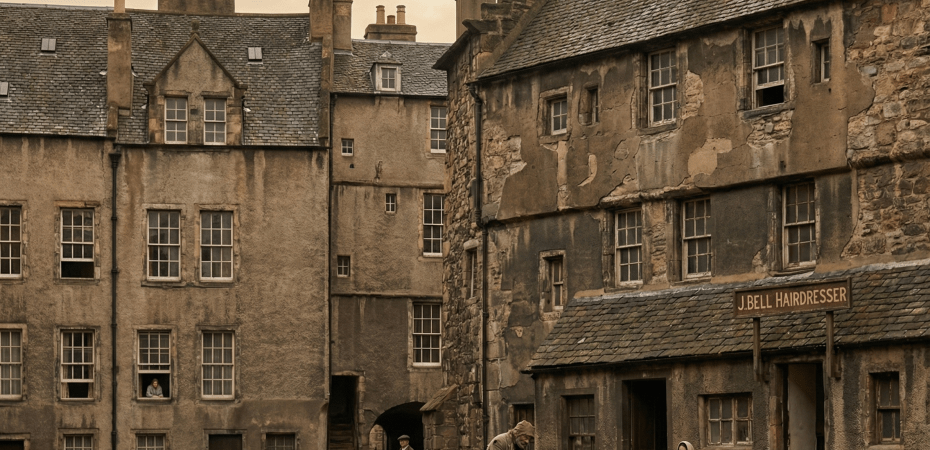
On Monday morning, a blacksmith named Chalmers, residing in a house at the foot of Candlemaker Row, was killed by his fellow-lodger, named Ransted, a pensioner, and light porter. The two men occupied the same room, and slept together. They were both middle-aged—the deceased being the younger—and unmarried. It was understood that they had occasional disagreements, and Chalmers had, about a month ago, expressed to his landlady a fear that he must leave, as his life was not safe with his companion. On Sunday they had been drinking together, and on coming home had quarrelled. On Monday morning Chalmers went out to work, and returned at nine to breakfast, but said to his landlady that he felt so ill from Sunday’s drinking that he would not go back again that day. He then went into his apartment, where Ransted was, and where, evidently, the quarrel recommenced. The landlady, however, heard nothing that led her to interfere ; but, from a window opposite, Ransted was distinctly seen to strike Chalmers twice with his fist, first on the cheek, and then on or behind the ear—Chalmers offering no resistance. On the repeated stroke, the man’s head drooped on his breast, and his assailant, evidently alarmed at the injury he had done him, called assistance. He was immediately laid on a bed, and medical aid was sent for, in the search for which Ransted himself joined. The unfortunate man, however, never moved nor spoke afterwards, having expired almost instantaneously. A little blood was found in his mouth ; but there was no other mark of external injury upon him. Ransted, when he discovered that Chalmers was dead, betrayed great alarm, and said that, as he would be hanged for it, he would go and drown himself in the canal ; and he managed to make his escape before the police were apprised of the circumstances. He was, however, captured in the afternoon, by M’Levy, in the Water of Leith village, where he had gone to take refuge with some friends. He was brought before the Police Court yesterday, and remitted to the Fiscal.
October 1853
 James McLevy