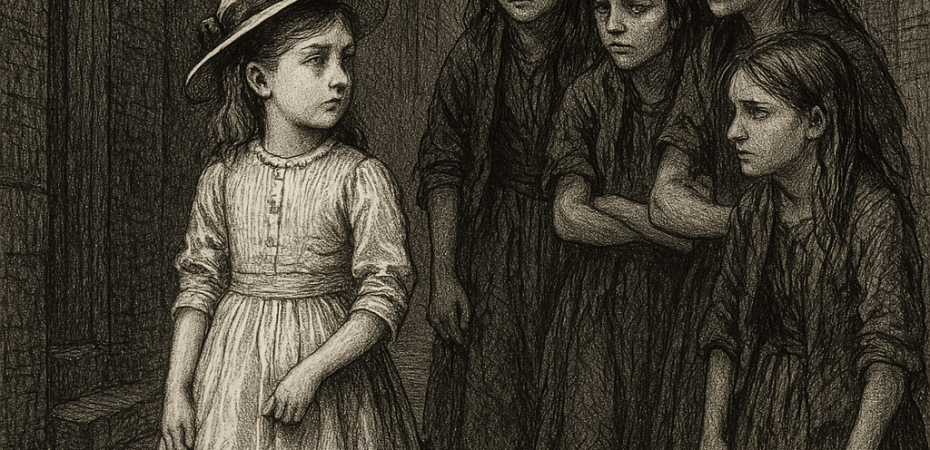
Child-stripping was a disturbing but widespread Victorian crime in which young children were lured into quiet places and stripped of their clothing, which was then pawned for money. Although Victorian writers like Dickens depicted the offenders as sinister older women, recent research suggests a very different reality.
Who Were the Offenders?
Newspaper evidence from 1800–1900 shows that many perpetrators were older children, particularly girls aged 12–14, targeting children even younger.
Research “demonstrates that child-stripping… was actually perpetrated by older children, notably girls.”
Where Did It Happen?
Child-stripping was concentrated in rapidly growing industrial cities such as Edinburgh, Glasgow, and Liverpool, where poverty, overcrowded housing, and the anonymity of urban life created opportunities for such crimes.
How Did the Crime Work?
Offenders frequently targeted toddlers and infants in:
- Back courts
- Stairwells
- Alleys and wynds
- Parks and waste ground
Victorian newspapers condemned it as an
“abhorrent species” and a “cowardly system of theft.”
Public Fear and “Moral Panic”
These incidents often triggered intense public anger and newspaper attention, contributing to wider Victorian anxieties about juvenile crime and social breakdown.
Reform, Not Retribution
While adult offenders were punished harshly, children were increasingly sent to reformatories and industrial schools, reflecting a shift in attitudes towards juvenile delinquency.
“Progressive attitudes largely prevailed with most child-stripping children being sent to reformatories or industrial schools.”
Quotes from MACRAILD, DONALD M., and FRANK NEAL. “Child-Stripping in the Victorian City.” Urban History 39, no. 3 (2012): 431–52. http://www.jstor.org/stable/26398152.
 James McLevy