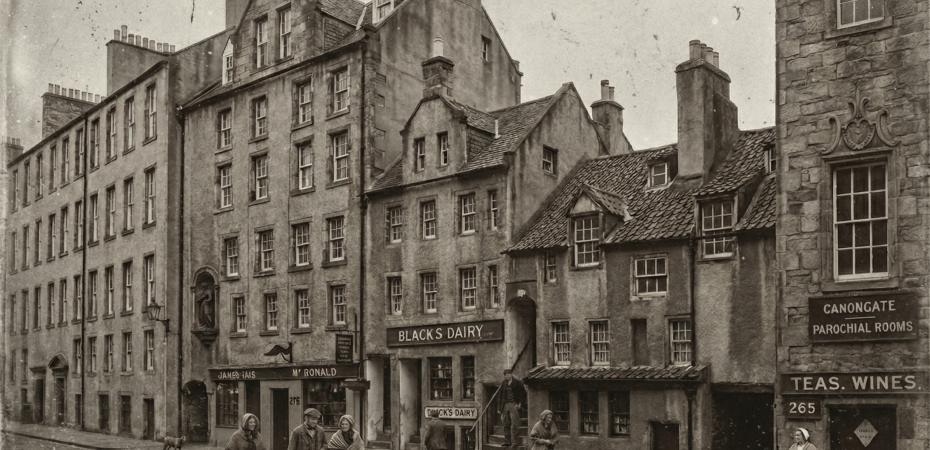
“Morocco Land” is a famous tenement building located at 265 Canongate in Edinburgh, which is historically significant because of the curious statue of a turbaned “Moor” projecting from its façade.
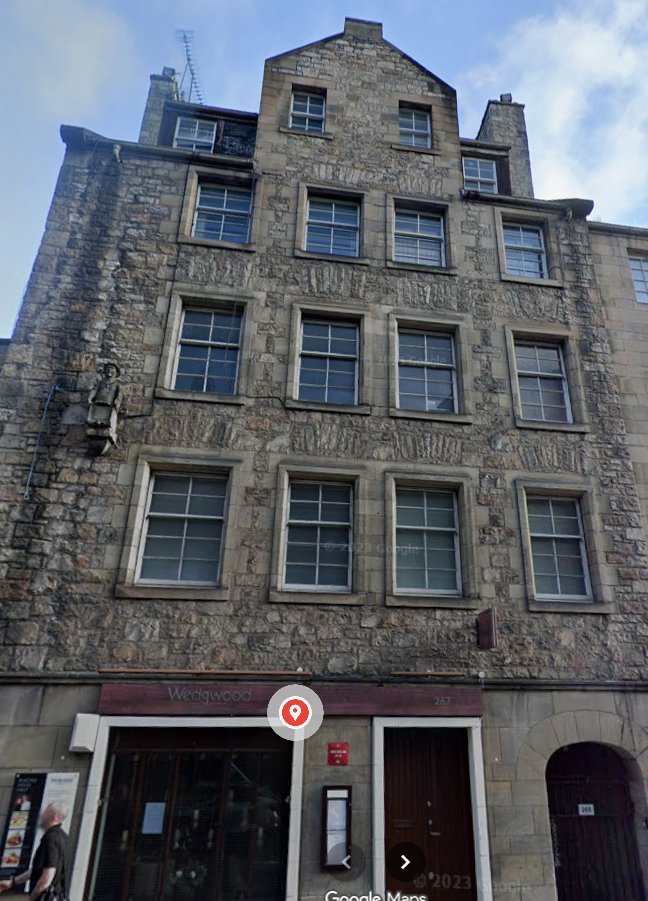
Edinburgh Morocco Land, named after Andrew Gray who was in the service of the Emperor of Morocco, is a 20th-century redevelopment of an early 18th-century tenement that stood to the east of the present site and was a storey higher. The effigy of a Moor with a turban, ear-rings, armlets, bracelets and a necklet, sits in a roughly formed niche in the wall of the tenement between the first and second floors. Andrew Gray, arrested at a City riot, escaped to Morocco. He became Commander of the Emperor’s Navy. In 1645, he returned and cured the Provost’s daughter of the plague, using an Eastern medicine. They fell in love, married and lived in Morocco Land
This account is taken from Reynolds’s miscellany of romance, general literature, science, and art; London Vol. 19, Iss. 479, (Sep 12, 1857): 104-104.
“The Tolbooth is rich in the memories of the past. We select the following as one of the most interesting and romantic legends connected with this ancient prison:—During one of the outbreaks, soon after the accession of Charles the First, the Provost’s house was broken into and fired by a band of rioters. The latter were subsequently seized and tried, when one Andrew Gray, a young man of good family, being convicted as the ringleader, was sentenced to death, and lay awaiting his execution in Canongate Gaol. Fortunately for him, Andrew had powerful friends, who did not desert him in his need, and a devoted vassal contrived to convey to him a rope and a file, after taking the precaution to drug the posset of the sentinel at the “Passes,” which was the name given to the ground floor of the Tolbooth. In one of the neighbouring closes of the Canongate, a boat had been prepared which took him over the North Loch, and he was sailing away near the mouth of the Frith, long before the town gates were opened next morning. Many years after, when these events were forgotten, the plague broke out in Edinburgh in 1645, and such was the panic that the debtors in the Tolbooth were set free, and all who were not freemen were compelled to vacate the town under heavy penalties. While undermined by this gaunt enemy from within, the inhabitants were dreading an attack from Montrose’s army, and preparing to repel their equally formidable enemy from without. Just at this juncture a foreign-looking vessel sailed up the Frith, which being at once set down for an Algerine pirate, greatly added to the panic already prevailing. Presently a detachment descended from the ship and proceeded towards the town, which it approached by the Water Gate, and marching through the High-street of the Canongate, demanded admission at the Nether Bow Port. The magistrates of the city then held a parley with the leader of the troop, and offered him an enormous ransom if he would retire, while he warned him at the same time that the plague was raging, but all in vain. The Provost, Sir John Smith, withdrew to hold council, and subsequently returned with a body of citizens, amongst whom was his brother-in-law, Sir William Gray, and resumed the negotiations. A ransom was at last accepted by the leader of the pirates, provided the Provost’s son was delivered up to him, when the information that his only child was a daughter then stricken with the plague, seemed to effect a change in the Moor’s designs. After a talk with his followers, he told the father he possessed an elixir which would cure her were she entrusted to him, pledging himself, should he not succeed, to embark and free the city without a ransom. The Provost now proposed the chieftain should enter the city and stay in his house, but this the Moor declined, as well as all offers of a higher ransom. Sir John at last yielded to his friend’s exhortations. The sick damsel was taken to a house at the head of the Canongate, where the Moor took up his abode, and shortly after restored her, perfectly cured, to her father. The Moorish leader turned out to be no other than Andrew Gray, who had been captured by pirates and sold to the Emperor of Morocco, in whose favour he rose to rank and wealth. He had returned to his native land to be revenged on the magistrates of Edinburgh, when he unexpectedly found the especial object of his vengeance was his own relation! The end was that he married the Provost’s daughter and remained in Edinburgh. The house where he cured the lady is still adorned with the turbaned effigy of the Emperor of Morocco, and the tenement has since borne the name of Morocco Land. Having vowed not to enter the city save sword in hand, he kept his vow by never passing the threshold of Nether Bow Port. Although Wilson, from whose delightful work called the “Memorials of Edinburgh” we have borrowed this pleasing legend, refuses to vouch for its authenticity, there seems a strong presumptive evidence of its being founded on fact. Indeed every inch of ground in the Canongate is fraught with some more or less romantic recollection; and the history of each individual building in the main street of this curious neighbourhood, would form a most interesting volume. Those who are inclined to become acquainted with the characters who once peopled it, may refer with advantage to Robert Chambers’s charming gossiping book on the Traditions of Edinburgh, containing a most graphic account of the Canongate.”
Memorials of Edinburgh in the olden time by Wilson, Daniel, Sir, 1816-1892 was published in 1848 and says
“We only add, that we do not pretend to guarantee this romantic legend of the Burgh ; all we have done has been to put into a consistent whole the different versions related to us. We have had the curiosity to obtain a sight of the title-deeds of the property, which prove to be of recent date. The earliest, a disposition of 1731, so far confirms the tale, that the proprietor at that date is John Gray, merchant, a descendant, it may be, of the Algerine rover and the Provost’s daughter. The figure of the Moor has ever been a subject of popular admiration and wonder, and a variety of legends are told to account for its existence. Most of them, however, though differing in almost every other point, seem to agree in connecting it with the last visitation of the plague.”
The building standing today at 265 Canongate is actually a 1950s reconstruction (by architect Robert Hurd) that replicated the original style, but they carefully preserved and re-installed the original Moor’s Head statue, which you can still see there today.
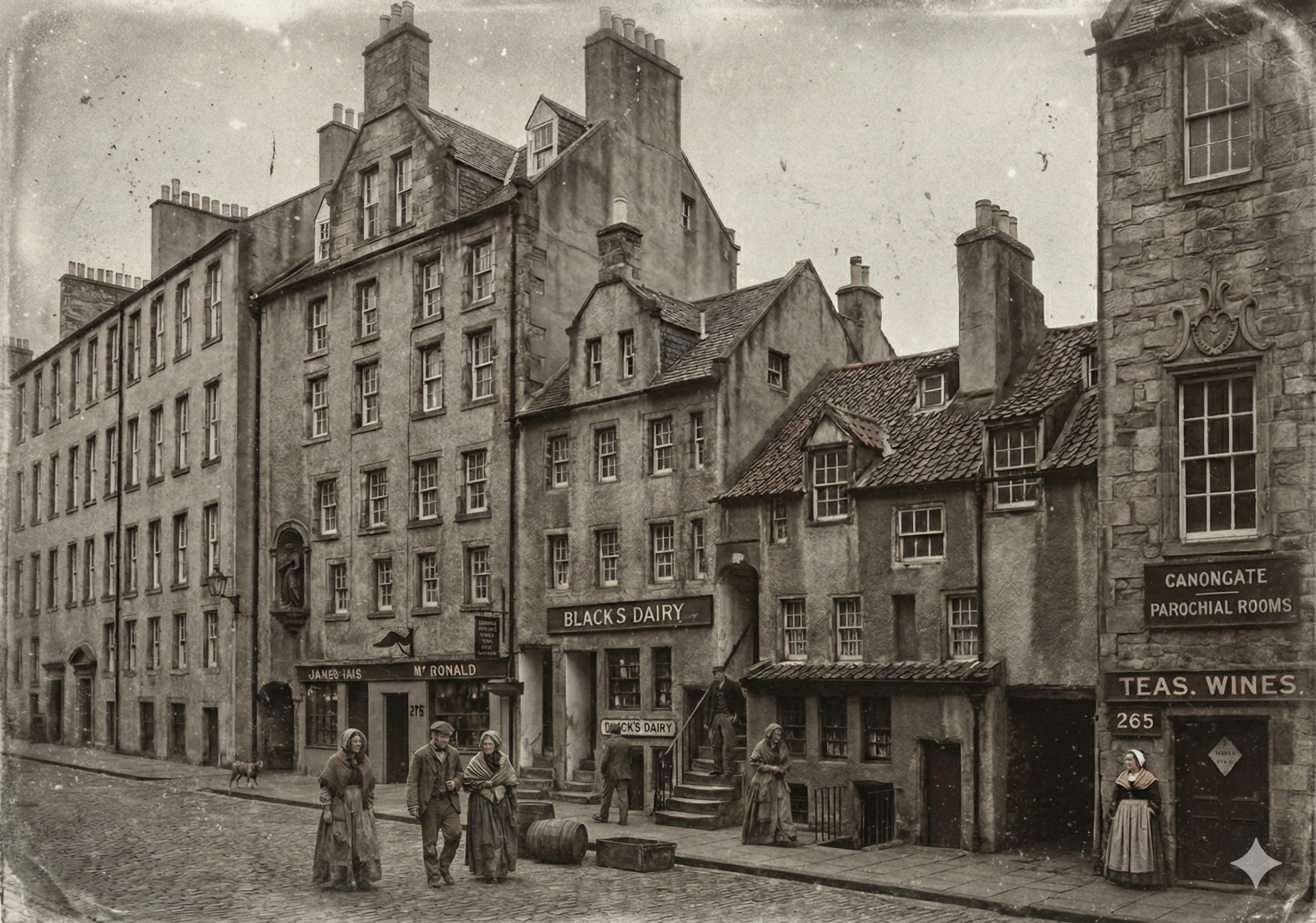
The Post Office street directory from 1860 confirms James Gray baker operated there

 James McLevy